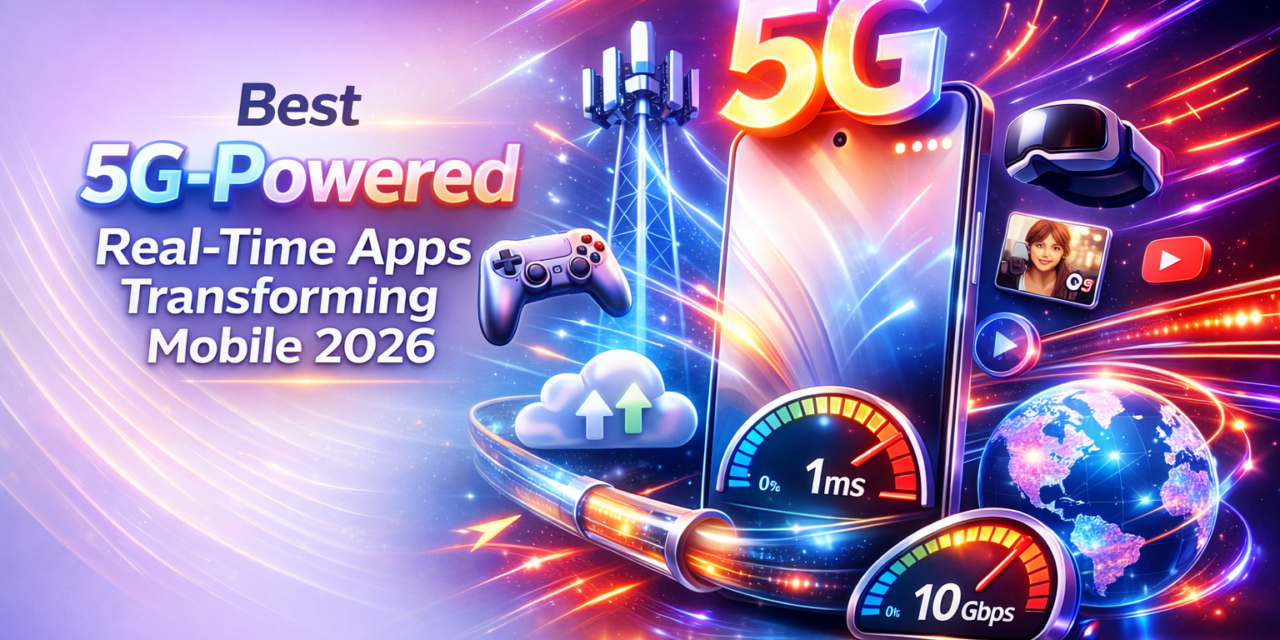
The 5G revolution has finally delivered on its promises in 2026. After years of infrastructure buildout and limited coverage, 5G networks now reach 70% of the global population with consistent gigabit speeds and sub-20ms latency. This connectivity leap hasn’t just made existing apps faster—it’s enabled entirely new categories of real-time applications impossible with 4G. Cloud gaming platforms stream AAA titles without downloads or consoles, AR applications overlay digital information with zero noticeable lag, and collaborative tools enable instantaneous synchronization across global teams. According to Ericsson, 5G subscriptions reached 1.9 billion globally in 2026, with the technology finally transforming from marketing buzzword to essential infrastructure powering next-generation mobile experiences.
Why 5G Changes Everything in 2026
4G LTE offers 50-100 Mbps speeds with 30-50ms latency—adequate for streaming and browsing but insufficient for real-time interactive experiences. 5G delivers 1-10 Gbps speeds with 1-10ms latency, reducing lag to imperceptible levels and enabling bandwidth-intensive applications. This isn’t incremental improvement—it’s transformative. Game streaming becomes indistinguishable from local play, AR glasses display information with no delay, and video collaboration achieves in-person quality. Cloud computing shifts to edge computing, processing data near users for instantaneous responses. The real impact shows in new application categories: you can’t stream Cyberpunk 2077 at 4K 60fps on 4G, but 5G makes it seamless. You can’t perform remote surgery with 50ms delay, but 10ms enables life-saving telemedicine.
Top 5G-Powered Apps for 2026
1. NVIDIA GeForce NOW – Cloud Gaming Leader
GeForce NOW dominates cloud gaming with 32 million members, streaming PC games from the cloud without downloads or expensive hardware.
Key Features:
- Stream from 1,800+ games library
- Up to 4K 120fps streaming
- RTX 4080-level graphics
- Cross-save with Steam, Epic, others
- Instant play—no downloads
- Mobile, TV, and browser access
- Ray tracing support
- Sub-20ms latency on 5G
5G Advantages: Zero buffering, instant loading, graphics quality matching local gaming on high-end PCs.
Best For: PC gamers without gaming rigs, mobile gaming, instant access
Pricing: Free tier (1-hour sessions); Priority $9.99/month; Ultimate $19.99/month
📥 Download Links:


2. Xbox Cloud Gaming – Console Gaming Anywhere
Microsoft’s cloud gaming service streams Xbox and PC games to any device with Game Pass Ultimate subscription.
Key Features:
- 400+ games via Game Pass library
- Play on phones, tablets, browsers
- Continue games across devices
- Controller support (Xbox, PlayStation)
- Touch controls for select games
- 1080p 60fps streaming
- Party chat integration
- Instant access to new releases
5G Advantages: Console-quality gaming on mobile with no noticeable input lag, playable competitively.
Best For: Xbox ecosystem users, Game Pass subscribers, mobile gaming
Pricing: Included with Game Pass Ultimate $16.99/month
📥 Download Links:
3. Amazon Luna – Streaming with Prime Integration

Amazon’s cloud gaming platform integrates with Prime and offers unique channel-based subscription model.
Key Features:
- Channel-based subscriptions
- Ubisoft+ integration
- Prime Gaming benefits
- Fire TV native support
- 4K streaming on select titles
- Luna Controller (WiFi direct)
- Cross-device gaming
- Family sharing
5G Advantages: Stream triple-A titles at 1080p 60fps on mobile with minimal latency.
Best For: Prime members, Ubisoft fans, Fire TV users
Pricing: Luna+ $9.99/month; various channel subscriptions
📥 Download Links:
4. Meta Horizon Worlds – Social VR Platform

Meta’s social VR platform enables real-time multiplayer experiences with Quest headsets and mobile access.
Key Features:
- Create and explore virtual worlds
- Real-time multiplayer (up to 20 users)
- User-generated content
- Avatar customization
- Voice chat with spatial audio
- Cross-platform (Quest, mobile)
- Events and concerts
- Creator monetization
5G Advantages: Mobile VR experiences with low latency for immersive, lag-free social interactions.
Best For: VR social experiences, virtual events, creators
Pricing: Free
📥 Download Links:
5. Microsoft Teams (5G Enhanced) – Enterprise Collaboration
Microsoft Teams leverages 5G for enhanced real-time collaboration with HD video and instant synchronization.
Key Features:
- HD video conferencing (1080p)
- Real-time document collaboration
- Instant file syncing
- Screen sharing without lag
- Together Mode (AI backgrounds)
- Live transcription and translation
- Whiteboard collaboration
- Third-party app integrations
5G Advantages: Flawless HD video conferences on mobile, instant document syncing, zero collaboration lag.
Best For: Remote workers, enterprise teams, mobile professionals
Pricing: Free basic; Microsoft 365 plans from $6/month
📥 Download Links:
7. Shadow PC – Full Desktop in Cloud
Shadow streams complete Windows PC from cloud, enabling full desktop applications on any device.
Key Features:
- Full Windows 10/11 desktop
- GTX 1080-equivalent GPU
- 256GB-1TB storage
- USB device forwarding
- Multiple monitor support
- Run any Windows software
- Game installation freedom
- 4K streaming capability
5G Advantages: Desktop experience on mobile with imperceptible latency for productivity and gaming.
Best For: Power users, professionals, gamers without PCs
Pricing: Power $29.99/month; Ultimate $44.99/month
📥 Download Links:
💡 Choosing the Right 5G App
By Use Case:
- Gaming: GeForce NOW (PC games), Xbox Cloud (console)
- Social VR: Meta Horizon Worlds
- AR experiences: Niantic Lightship platform
- Productivity: Shadow PC, Microsoft Teams
- Streaming variety: Amazon Luna (channels)
By Platform:
✅ PC gamers → GeForce NOW
✅ Xbox fans → Xbox Cloud Gaming
✅ Mobile productivity → Shadow PC, Teams
✅ AR enthusiasts → Niantic apps
✅ VR social → Meta Horizon
5G-Enabled Experiences
Cloud Gaming Revolution:
Download-free gaming becomes mainstream. AAA titles playable instantly on any device without gigabytes of downloads or expensive hardware. 5G’s bandwidth handles 4K streaming while low latency makes competitive gaming viable.
Real-Time AR:
Augmented reality overlays respond instantly to movements. Multiplayer AR experiences synchronize across users without lag. Navigation, shopping, and social AR become seamless.
Mobile Cloud Computing:
Access desktop-class applications on smartphones. Video editing, 3D rendering, and professional software run from cloud with desktop performance on mobile displays.
Instant Collaboration:
Video conferences achieve in-person quality. Document collaboration occurs simultaneously without sync delays. Remote work experiences match office environments.
Telemedicine Advancement:
High-definition video consultations enable accurate diagnoses. Remote surgery becomes viable with sub-10ms latency. Wearable health monitors stream real-time data to providers.
5G Performance Statistics 2026
Network Performance:
- Average 5G speed: 1.2 Gbps (vs. 4G: 50 Mbps)
- Latency: 10-15ms (vs. 4G: 40-50ms)
- Global coverage: 70% of population
- Subscriptions: 1.9 billion worldwide
Application Impact:
- Cloud gaming latency: 15-25ms average
- 4K streaming: Zero buffering on 5G
- AR applications: Sub-10ms response time
- Video calls: 1080p HD standard on mobile
5G Technology Trends 2026
Edge Computing Integration: Processing moves closer to users through edge data centers, reducing latency further. Applications compute at network edge rather than distant servers.
Standalone 5G (SA) Rollout: True 5G networks (not relying on 4G infrastructure) deliver full performance. SA networks enable features like network slicing for guaranteed quality.
mmWave Expansion: Millimeter wave 5G provides multi-gigabit speeds in dense urban areas. Coverage expands beyond stadiums and airports to broader deployment.
Private 5G Networks: Enterprises deploy private 5G for factories, warehouses, and campuses, enabling industrial IoT and autonomous systems.
6G Research: While 5G matures, research begins on 6G (expected 2030), promising 100x faster speeds and 1ms latency.
5G Plan Considerations
Carrier Pricing (US Average):
- Unlimited 5G: $60-80/month
- Family plans: $35-50/user with multiple lines
- Prepaid 5G: $40-60/month
Data Consumption:
- 4K cloud gaming: 15-25 GB/hour
- HD video calls: 2-4 GB/hour
- AR applications: 1-3 GB/hour
- General browsing: Similar to 4G
Unlimited Plans Essential: 5G apps consume significantly more data. Unlimited plans with priority data are recommended for heavy cloud gaming and streaming users.
Conclusion
5G has transitioned from marketing promise to practical reality in 2026, enabling applications fundamentally impossible with 4G. Cloud gaming platforms like GeForce NOW and Xbox Cloud deliver console experiences without hardware, AR applications respond instantaneously, and collaboration tools achieve in-person quality remotely. With 70% global coverage and 1.9 billion subscriptions, 5G infrastructure has matured sufficiently to support bandwidth-intensive, latency-sensitive applications at scale.
Experience 5G today by trying cloud gaming services or enhanced AR applications in areas with coverage. The difference between 4G and 5G becomes immediately apparent when streaming games at 4K or collaborating in real-time. As standalone 5G networks expand and edge computing matures, expect even more impressive applications. The mobile revolution’s next chapter isn’t about faster phones—it’s about computational power, storage, and processing moving to the cloud while 5G connectivity makes the experience seamless. Welcome to the instant app era.
FAQ
1. Do I need 5G to use these apps?
Technically no, but experiences are dramatically degraded on 4G. Cloud gaming becomes unplayable with lag and buffering. AR applications respond slowly. 5G isn’t optional for optimal experiences—it’s essential.
2. How much data does cloud gaming use on 5G?
Significant amounts: 4K gaming consumes 15-25 GB/hour, 1080p uses 5-10 GB/hour. Unlimited 5G plans are strongly recommended for regular cloud gaming to avoid overage charges.
3. Is 5G coverage widespread enough in 2026?
In urban areas, yes. 5G reaches 70% of global population, with excellent coverage in cities. Rural areas still rely primarily on 4G. Check carrier coverage maps before relying on 5G apps.
4. Will 5G drain my phone battery faster?
Initially yes, but 2026 phones optimize 5G power consumption. Expect 10-20% faster battery drain with active 5G use. Newer devices (2025-2026 models) manage 5G more efficiently than early adopters.
5. Can I play competitive games on cloud gaming with 5G?
Yes! With 15-25ms total latency (network + service), competitive gaming is viable. Professional esports players still prefer local play, but casual competitive play works well on 5G cloud gaming platforms.