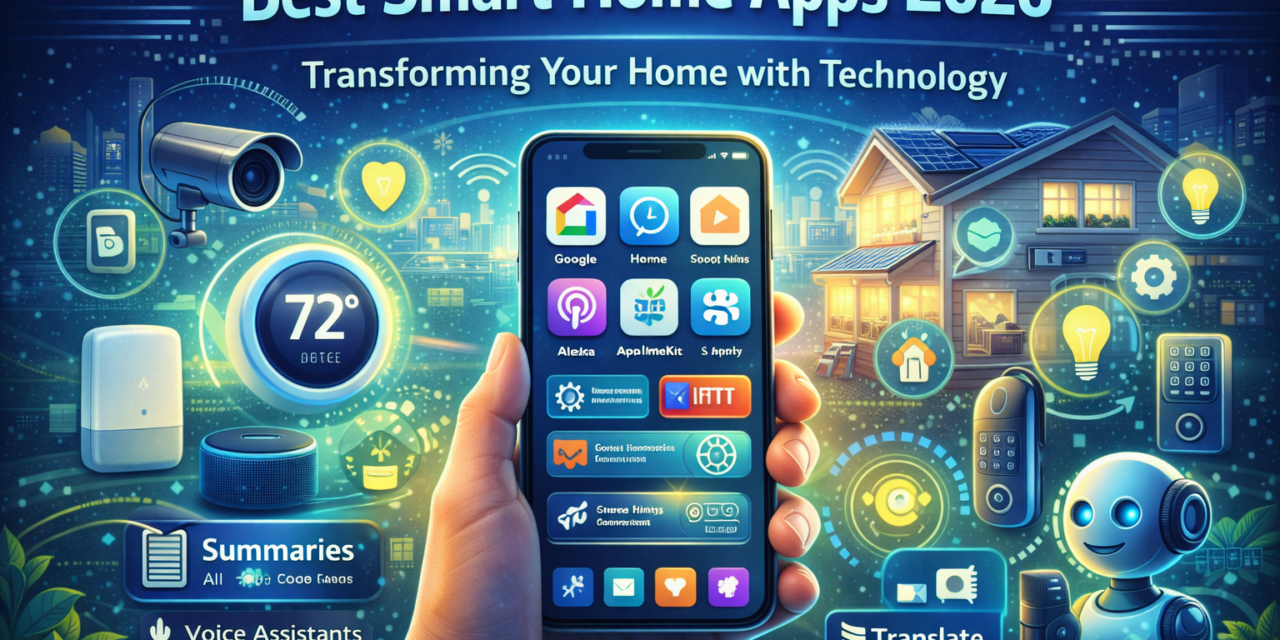
The smart home revolution has reached mainstream adoption in 2026, with 127 million connected homes globally and the market valued at $174 billion. What began as expensive tech enthusiast toys has evolved into accessible, practical systems enhancing comfort, security, and efficiency for average homeowners. From voice-controlled lighting to AI-powered climate optimization, automated security systems to energy monitoring reducing utility bills by 20-30%, smart home apps centralize control of dozens of connected devices through single interfaces. Industry data shows 68% of new homes now include smart features as standard, while retrofit adoption accelerates as devices become more affordable and user-friendly. The integration of AI transforms static automation into predictive systems that learn preferences and optimize automatically.
🏠 Why Smart Home Apps Matter in 2026
Traditional homes require manual control of every system—adjusting thermostats, checking security cameras, turning off forgotten lights. Smart home apps eliminate this friction, providing centralized control of lighting, climate, security, entertainment, and appliances through smartphones or voice commands. The benefits extend beyond convenience: automated climate control reduces energy costs 20-30%, smart security systems deter break-ins and provide instant alerts, and routine automation saves 45 minutes daily on average through eliminated repetitive tasks. As devices become interoperable through Matter standard adoption, single apps now control products from multiple manufacturers, ending the fragmentation that plagued early smart homes.
📱 Top Home Automation and Smart Home Apps for 2026
1. Google Home – Ecosystem Integration Leader
Google Home dominates with seamless integration across Google services, Nest products, and thousands of third-party devices.
Key Features:
- Control Nest thermostats, cameras, doorbells
- Voice control through Google Assistant
- Routine automation (morning, bedtime, leaving)
- Energy usage tracking and insights
- Integration with 10,000+ smart devices
- Family sharing and multi-user support
- Room-based organization
- Matter standard support
Automation Examples: “Good morning” routine turns on lights, adjusts thermostat, reads news and weather, starts coffee maker
Best For: Android users, Nest device owners, Google ecosystem
Pricing: Free app; devices sold separately
2. Amazon Alexa – Voice Control Pioneer
Alexa leads in voice-first control with 500 million devices worldwide and extensive smart home device compatibility.
Key Features:
- Voice control for 100,000+ compatible devices
- Skills marketplace for extended functionality
- Multi-room audio synchronization
- Guard mode for security monitoring
- Energy dashboard tracking consumption
- Hunches (AI suggestions based on patterns)
- Drop-in communication between devices
- Matter and Thread support
Smart Features: Alexa learns patterns suggesting “you usually turn off bedroom lights at 10:30pm”
Best For: Alexa device owners, voice-first control, Amazon ecosystem
Pricing: Free app; Alexa devices sold separately
3. Apple Home (HomeKit) – Privacy-Focused Control
Apple Home emphasizes security and privacy with end-to-end encryption for all smart home communications.
Key Features:
- End-to-end encryption for all devices
- Siri voice control integration
- HomeKit Secure Video (encrypted cloud storage)
- Automation with conditions and triggers
- Home hub through Apple TV/HomePod
- Family sharing across devices
- Scene creation for multi-device control
- Matter standard support
Privacy Advantage: All communications encrypted, video stored with end-to-end encryption, no cloud processing of voice commands
Best For: iPhone/iPad users, privacy-conscious, Apple ecosystem
Pricing: Free app; compatible devices required
Access: Pre-installed on iOS devices
4. Samsung SmartThings – Universal Hub Platform
SmartThings works as universal hub supporting widest range of devices across brands and protocols.
Key Features:
- Compatible with 5,000+ devices
- Z-Wave, Zigbee, WiFi, Matter support
- Custom automation creation
- Scenes for multi-device control
- Energy monitoring
- Bixby and Alexa voice control
- Third-party integration (Google, IFTTT)
- Local processing for faster response
Flexibility: Mix-and-match devices from any manufacturer without ecosystem lock-in
Best For: Samsung device owners, multi-brand setups, customization enthusiasts
Pricing: Free app; SmartThings Hub $70
5. Home Assistant – Open-Source Powerhouse
Home Assistant offers ultimate customization and privacy for tech-savvy users willing to self-host.
Key Features:
- 2,000+ device integrations
- Completely local processing (no cloud)
- Advanced automation engine
- Custom dashboards
- Voice control (Google, Alexa, Siri)
- Energy management
- Presence detection
- Community add-ons and integrations
Advanced Automation: Complex conditions, multiple triggers, custom scripts beyond capabilities of commercial platforms
Best For: Tech enthusiasts, privacy advocates, advanced automation
Pricing: Free open-source; optional cloud features $6.50/month
6. IFTTT – Cross-Platform Automation
IFTTT (If This Then That) connects apps and devices across platforms enabling automations impossible within single ecosystems.
Key Features:
- 800+ service integrations
- Simple “if this then that” logic
- Cross-platform automations
- Social media integration
- Weather triggers
- Location-based automation
- Time-based schedules
- Applet marketplace
Unique Capabilities: Connect smart home to social media, email, weather, calendars, and services beyond traditional smart home platforms
Best For: Cross-platform automation, creative triggers, service integration
Pricing: Free; Pro $2.50/month for unlimited applets
7. Brilliant – Smart Home Control Panel
Brilliant replaces light switches with touchscreen control panels managing all smart home devices.
Key Features:
- Touchscreen control panels
- Replace existing light switches
- Integrate with all major platforms
- Music streaming control
- Video doorbell display
- Climate control
- Scene activation
- Voice control integration
Physical Control: Provides dedicated wall-mounted controls for those preferring tactile interfaces over phones
Best For: Whole-home installations, physical control preference, luxury homes
Pricing: Control panels from $299-$599
💡 Choosing Your Smart Home Platform
By Ecosystem:
- Google users: Google Home (Nest integration)
- Amazon users: Alexa (Echo devices, shopping)
- Apple users: HomeKit (privacy, security)
- Samsung users: SmartThings (device compatibility)
- Tech enthusiasts: Home Assistant (customization)
By Priority:
✅ Privacy → Apple HomeKit (encryption)
✅ Voice control → Alexa, Google Home
✅ Compatibility → SmartThings, Home Assistant
✅ Simplicity → Google Home, Apple HomeKit
✅ Customization → Home Assistant, SmartThings
🎯 Smart Home Automation Ideas
Morning Routine:
Alarm triggers gradual light brightening, adjusts thermostat to comfortable temperature, starts coffee maker, reads news and weather
Leaving Home:
Locks doors, arms security, adjusts thermostat to eco mode, turns off all lights, closes garage door
Movie Night: Single command dims lights, closes smart blinds, turns on TV and sound system, adjusts room temperature
Energy Saving:
Automatically adjusts thermostat based on occupancy, turns off lights in empty rooms, optimizes appliance usage during off-peak electricity rates
Security:
Motion detected when away triggers camera recording, sends alerts, turns on lights, and sounds alarm if entry detected
📊 Smart Home Market Statistics 2026
Adoption:
- 127 million connected homes globally
- $174 billion market value
- 68% of new homes include smart features
- Average home: 12 connected devices
Benefits:
- 20-30% energy cost reduction
- 45 minutes daily time savings
- 67% report improved home security
- $800 average annual savings
Device Categories:
- Smart speakers/displays: 42% adoption
- Smart lighting: 38% adoption
- Smart thermostats: 31% adoption
- Security cameras: 29% adoption
- Smart locks: 24% adoption
🚀 Smart Home Trends 2026
Matter Standard Adoption:
Universal standard enabling devices from different manufacturers to work together seamlessly, ending ecosystem fragmentation
AI-Powered Optimization:
Systems learn preferences and optimize automatically—adjusting temperature based on occupancy patterns, pre-heating before arrival
Energy Management:
Smart homes actively manage energy usage, shifting consumption to off-peak hours, integrating solar panels and battery storage
Health Monitoring:
Ambient sensors detect falls, monitor sleep quality, and track activity levels, especially valuable for elderly care
Voice-First Control:
Voice commands becoming primary interface as accuracy improves and natural language understanding advances
🔑 Conclusion
Smart home apps have evolved from complex tech projects to user-friendly platforms transforming daily living in 2026. Google Home leads Android integration, Alexa dominates voice control, Apple HomeKit prioritizes privacy, and SmartThings offers universal compatibility. With 127 million connected homes and average $800 annual savings through energy efficiency, smart home technology has proven practical value beyond convenience. The Matter standard adoption finally delivers the interoperability promised for years, enabling users to choose best devices without ecosystem lock-in.
Start your smart home journey today by choosing a platform matching your existing ecosystem and beginning with simple devices like smart bulbs or plugs. Expand gradually as you discover automation opportunities unique to your lifestyle. The future home isn’t just connected—it’s intelligent, learning your preferences and optimizing automatically. Welcome home to 2026.
❓ FAQ
1. Which smart home platform is best?
Depends on ecosystem: Google Home for Android/Nest users, Alexa for voice-first control and Amazon integration, HomeKit for iPhone users prioritizing privacy, SmartThings for multi-brand flexibility.
2. Do smart homes really save energy?
Yes! Smart thermostats alone save 10-23% on heating/cooling. Whole-home automation (lights, climate, appliances) achieves 20-30% total reduction, averaging $800 annually for typical homes.
3. Are smart homes secure from hackers?
Reputable platforms implement strong security, but risks exist. Use strong unique passwords, enable two-factor authentication, keep devices updated, use separate WiFi network for IoT devices, and avoid unknown brands.
4. Can I mix devices from different brands?
Yes, especially with Matter standard adoption in 2026. Platforms like SmartThings, Home Assistant, and IFTTT excel at integrating multi-brand setups. Avoid proprietary ecosystems for maximum flexibility.
5. How much does a smart home cost to set up?
Entry level: $200-500 (smart speaker, bulbs, plugs). Mid-range: $1,000-2,500 (thermostat, locks, cameras, sensors). Comprehensive: $5,000-15,000+ (whole-home automation with professional installation). Start small and expand gradually.