
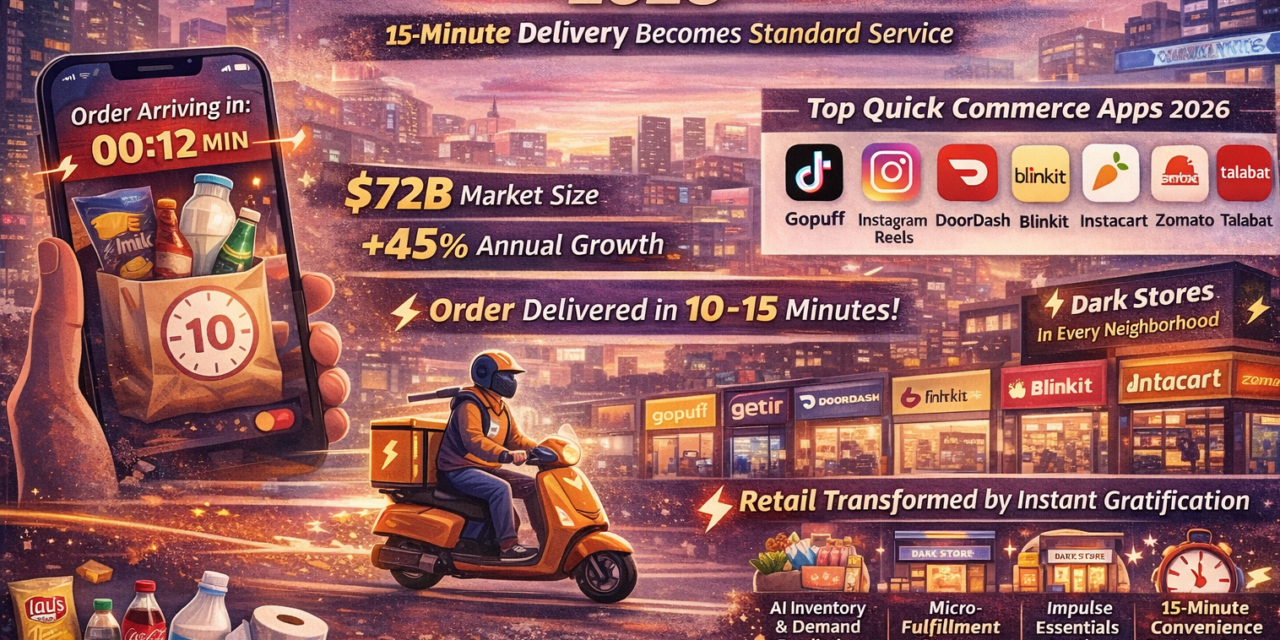
The quick commerce revolution has transformed consumer expectations in 2026, with “15-minute delivery” evolving from luxury to standard service across urban areas. The $72 billion quick commerce market grows 45% annually as instant gratification becomes normalized—consumers now order single items multiple times daily rather than weekly bulk shopping. From Gopuff’s US dominance to Getir’s European expansion and Blinkit’s Indian market leadership, platforms use predictive AI positioning inventory near anticipated demand, dynamic pricing during peak times, and dark stores (micro-fulfillment centers) in every neighborhood. Average order values dropped to $15-25 as shopping behavior shifts from planned trips to impulse convenience, fundamentally disrupting traditional retail and grocery delivery models built around consolidated orders.
⚡ Why 15-Minute Delivery Dominates 2026
Traditional delivery requires planning ahead—ordering groceries hours or day in advance for scheduled windows. Quick commerce eliminates this friction entirely, delivering within minutes from order placement. The model succeeds through hyper-local dark stores stocking 2,000-3,000 high-velocity SKUs within 2-mile radius of delivery zones. Predictive AI forecasts neighborhood demand hourly, pre-positioning inventory to minimize fulfillment time. Consumers embrace spontaneous ordering—forgot milk for morning coffee? Order arrives in 12 minutes. Craving specific snack? Delivered faster than driving to store. This convenience commands premium pricing—customers pay 20-40% markup plus delivery fees, yet adoption accelerates as time-starved urban consumers prioritize speed over savings.
📱 Top Quick Commerce and 15-Minute Delivery Apps 2026
1. Gopuff – US Quick Commerce Leader
Gopuff dominates American quick commerce with 650+ micro-fulfillment centers delivering essentials in minutes from own inventory.
Key Features:
- 15-30 minute delivery guarantee
- 4,000+ products (snacks, drinks, essentials, alcohol)
- Own inventory and logistics
- Flat $2.95 delivery fee
- Gopuff+ membership (unlimited free delivery)
- 24/7 availability in most markets
- Order tracking
- Scheduled delivery option
Product Range: Snacks, beverages, alcohol, household essentials, pet supplies, baby products, OTC medicine
Best For: US customers, late-night delivery, alcohol, convenience items Pricing: $2.95 delivery; Gopuff+ $5.95/month unlimited free delivery
2. Getir – European Quick Commerce Pioneer
Getir pioneered 10-minute delivery in Turkey, expanding to Europe and US with aggressive growth and bright purple branding.
Key Features:
- 10-minute delivery promise
- 2,000+ essential items
- Own riders and dark stores
- Real-time order tracking
- Multiple payment methods
- Operating in 1,000+ cities
- Premium product selection
- No minimum order
Geographic Coverage: Strong European presence, expanding US operations, Middle East markets
Best For: European customers, ultra-fast delivery, essential items Pricing: Delivery fees vary by market (~$2-4)
3. DoorDash – Expanding Beyond Food
DoorDash evolved from food delivery to quick commerce with DashMart convenience stores offering 15-30 minute delivery.
Key Features:
- DashMart convenience items
- Pet supplies, household goods
- Integration with food delivery
- DashPass membership benefits
- Scheduled and ASAP delivery
- Wide product selection
- Existing Dasher network
- Same app as restaurant delivery
Advantage: Leverages existing delivery infrastructure and customer base from food delivery business
Best For: US customers, existing DoorDash users, combining food and convenience Pricing: Delivery fees vary; DashPass $9.99/month
4. Instacart – Grocery Quick Commerce
Instacart added “Fast & Flexible” instant delivery from convenience partners for essentials in minutes.
Key Features:
- 30-minute convenience delivery
- Traditional grocery (1-2 hours)
- Alcohol delivery (where legal)
- Prescription delivery
- 1,400+ retailer partnerships
- Personal shoppers
- Instacart+ membership
- Curbside pickup option
Hybrid Model: Combines traditional grocery delivery with quick commerce convenience offerings
Best For: US grocery delivery, alcohol, prescriptions, variety Pricing: Delivery fees vary; Instacart+ $9.99/month
5. Blinkit – India Quick Commerce Leader
Blinkit (formerly Grofers) dominates Indian quick commerce with hyperlocal delivery across major cities.
Key Features:
- 10-minute delivery in India
- 3,000+ products
- Fresh produce and groceries
- Household essentials
- Personal care items
- Competitive pricing
- Multiple payment options
- Wide city coverage in India
Market Position: Acquired by Zomato, leveraging food delivery infrastructure for quick commerce expansion
Best For: Indian customers, groceries, competitive pricing Pricing: Minimal delivery fees, varies by order value.
6. Zomato (Instant) – Food + Quick Commerce
Zomato expanded from food delivery to 10-minute grocery/essential delivery integrated within main app.
Key Features:
- Instant delivery (10 minutes)
- Groceries and essentials
- Integration with food delivery
- Wide restaurant network
- Zomato Gold membership
- Multiple payment options
- Pan-India coverage
- Combined food and grocery ordering
Integration: Single app for restaurant food and grocery convenience delivery
Best For: Indian market, food + grocery, integrated experience Pricing: Delivery fees vary by order
7. Talabat – Middle East Quick Commerce
Talabat dominates Middle East delivery with Talabat Mart offering quick commerce across Gulf region.
Key Features:
- 15-30 minute delivery
- Groceries and essentials
- Restaurant delivery integration
- Wide product range
- Multiple payment options
- Operating across 9 countries
- Talabat Plus membership
- Track order in real-time
Regional Strength: Market leader across UAE, Saudi Arabia, Kuwait, Qatar, Bahrain
Best For: Middle East customers, groceries, restaurant + convenience Pricing: Delivery fees vary; Talabat Plus subscription available
💡 Choosing Your Quick Commerce App
By Location:
- United States: Gopuff, DoorDash, Instacart
- Europe: Getir, Gorillas, Flink
- India: Blinkit, Zomato Instant, Swiggy Instamart
- Middle East: Talabat, Deliveroo
By Need:
✅ Ultra-fast (10-15 min) → Getir, Blinkit, Gopuff
✅ Groceries → Instacart, Blinkit, Zomato
✅ Late night → Gopuff (24/7)
✅ Alcohol → Gopuff, Instacart, Getir (where legal)
🎯 Maximizing Quick Commerce Value
Membership Programs:
Gopuff+, DashPass, Instacart+ eliminate per-order delivery fees. Break-even typically 3-4 orders monthly.
Order Optimization:
Quick commerce markup + delivery fees make small orders expensive. Combine needs into $20-30 orders when possible.
Peak Pricing:
Some platforms implement surge pricing during high-demand periods. Order during off-peak for lowest fees.
Subscription Stacking:
Many consumers subscribe to 2-3 services based on specific needs—Gopuff for convenience, Instacart for groceries.
📊 Quick Commerce Statistics 2026
Market Growth:
- $72 billion global market
- 45% annual growth rate
- Average delivery: 18 minutes
- Order frequency: 4.2x weekly (heavy users)
Consumer Behavior:
- Average order value: $15-25 (down from $45-60 in traditional delivery)
- 73% order impulsively vs. planned
- Premium willingness: 25% markup acceptance
- Urban adoption: 48% use weekly
🔑 Conclusion
Quick commerce has fundamentally transformed retail in 2026, with 15-minute delivery shifting from luxury to expectation across urban markets. Gopuff leads US convenience delivery, Getir dominates Europe with 10-minute promises, and Blinkit commands Indian markets. The $72 billion market growing 45% annually proves instant gratification commerce is here to stay. While 20-40% markups and delivery fees make quick commerce expensive, time-starved consumers increasingly value convenience over savings.
Start using quick commerce today by downloading your regional leader and testing for time-sensitive needs. Reserve quick commerce for genuine urgency and convenience while maintaining traditional grocery delivery or shopping for planned bulk purchases. The future of retail is hybrid—quick commerce for immediate needs, traditional delivery for weekly planning, and in-store for experience shopping.
❓ FAQ
1. Is quick commerce more expensive than traditional delivery?
Yes, products carry 20-40% markup plus delivery fees. However, membership programs eliminate per-order fees, making it comparable for frequent users.
2. How do they deliver so fast?
Micro-fulfillment centers (dark stores) located within 2 miles of delivery zones stock popular items. Predictive AI pre-positions inventory based on forecasted demand.
3. What’s the minimum order value?
Varies by platform—typically $0-10 minimum. However, small orders become expensive with delivery fees unless you have unlimited delivery membership.
4. Is quick commerce available 24/7?
Gopuff operates 24/7 in most markets. Others typically run 8am-midnight or 7am-2am depending on city and demand.
5. Will quick commerce replace traditional grocery shopping?
Unlikely to replace entirely. It serves immediate convenience needs while traditional shopping and planned delivery remain economical for bulk purchases. Most consumers use hybrid approach.