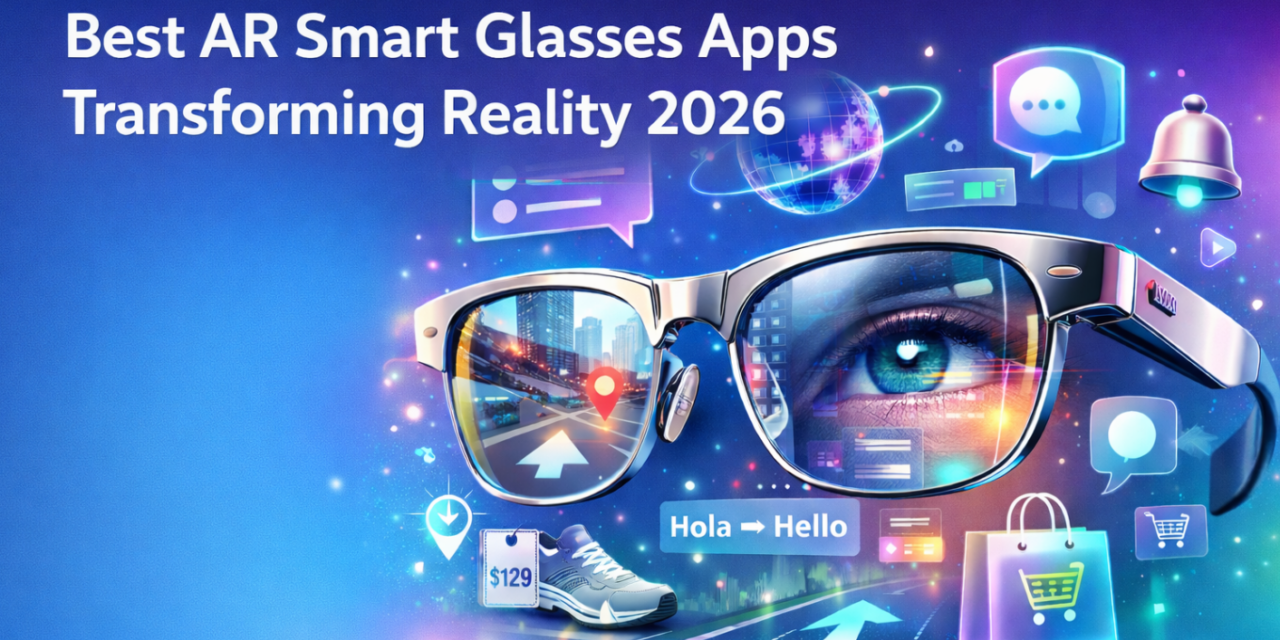
The augmented reality glasses revolution has finally arrived in 2026. After years of failed promises and clunky prototypes, AR smart glasses have evolved into sleek, everyday wearables that seamlessly blend digital information with the physical world. Industry analyst Tim Bajarin predicts “Apple glasses will be out by the end of 2026,” backed by Apple’s development efforts since 2017. Android XR AI display frames are launching this summer and will “quickly establish themselves among the must-have wearable gadgets of 2026” according to TechRadar. With Meta’s Ray-Ban smart glasses already mainstream and new AI-powered frames from multiple manufacturers, augmented reality has escaped research labs and entered consumer hands. The global AR market is projected to reach $97.76 billion in 2026, with smart glasses representing the fastest-growing segment.
Why AR Smart Glasses Matter in 2026
Traditional smartphones demand constant attention, forcing you to look down and disengage from surroundings. AR smart glasses project information directly into your natural line of sight, enabling hands-free access to navigation, notifications, translations, and AI assistance while maintaining eye contact with the world. The technology has finally matured—glasses are now light enough for all-day wear (under 100g), powerful enough for practical applications, and affordable enough for mainstream adoption ($299-$800 range). With AI integration accelerating, smart glasses have evolved from simple notification displays to proactive AI companions that understand context and anticipate needs.
Top AR Smart Glasses and Apps for 2026
1. Meta Ray-Ban Smart Glasses – Social AR Leader

Meta’s collaboration with Ray-Ban created the most commercially successful smart glasses, blending iconic eyewear style with practical AR capabilities.
Key Features:
- 12MP ultra-wide cameras for photos and video
- Open-ear audio with directional speakers
- Meta AI voice assistant integration
- Live view streaming to Instagram/Facebook
- Real-time translation display
- Turn-by-turn navigation overlays
- Prescription and polarized lens options
- 36-hour battery life with case
Popular Apps:
- Meta AI Assistant (voice queries, visual search)
- WhatsApp hands-free messaging
- Instagram/Facebook live streaming
- Spotify music control
- Google Maps AR navigation
- Translate AR (live text translation)
Best For: Social media creators, everyday wear, style-conscious users
Pricing: $299-$379 depending on lens type
📥 Download Links:

2. Apple Vision Pro Ecosystem – Spatial Computing Pioneer

While a mixed reality headset rather than glasses, Vision Pro’s spatial computing apps pioneered experiences that will transfer to Apple’s anticipated iGlasses.
Key Features:
- 4K micro-OLED displays per eye
- Hand and eye tracking (no controllers)
- Spatial audio with head tracking
- Mac virtual display
- 3D photo and video capture
- Apps floating in physical space
- FaceTime with spatial personas
- Thousands of iPad app compatibility
Essential Apps:
- Productivity: Pages, Keynote, Numbers in 3D space
- Entertainment: Disney+, Max with immersive viewing
- Collaboration: Zoom, Microsoft Teams spatial meetings
- Design: Shapr3D, JigSpace AR modeling
- Games: What the Golf, Spatial titles
Best For: Professionals, early adopters, content creators, developers
Pricing: $3,499
📥 Download Links:
3. Android XR Platform (Google/Samsung Partnership)

Google and Samsung’s Android XR platform launches summer 2026, bringing Android’s open ecosystem to AR glasses with deep Gemini AI integration.
Key Features:
- Gemini AI contextual assistance
- Voice-first natural interface
- Real-time AR navigation
- Live translation overlays
- Notification management
- Multi-app multitasking
- Cross-device continuity
- Developer SDK for custom apps
Expected Apps:
- Google Maps AR navigation
- Gmail and Messages integration
- Google Lens enhanced
- YouTube immersive viewing
- Gemini conversational AI
- Third-party app ecosystem
Best For: Android users, AI-powered experiences, developers Pricing: Various manufacturers, expected $400-$800 Launch: Summer 2026
📥 Download Links:
4. Xreal Air 2 Ultra – Entertainment & Gaming Focus

Xreal (formerly Nreal) specializes in high-quality displays for gaming and entertainment with 6DoF spatial tracking.
Key Features:
- Dual 1080p Sony micro-OLED displays
- 52° field of view
- 6DoF spatial tracking
- 3DoF mode for media consumption
- USB-C connectivity (phones, consoles, PCs)
- Electrochromic dimming
- Lightweight 80g design
- Prescription lens inserts available
Compatible Apps:
- Xbox Cloud Gaming
- NVIDIA GeForce NOW
- Steam Link
- Netflix/Disney+ portable theater
- Spatial web browsing
- Mobile gaming (AR Mode)
Best For: Gamers, entertainment enthusiasts, portable displays
Pricing: $699
📥 Download Links:
5. Vuzix Z100 – Enterprise AR Solutions

Vuzix targets enterprise users with professional-grade AR for hands-free workflows in manufacturing, logistics, and field services.
Key Features:
- Waveguide optics display
- Voice and gesture controls
- 8MP camera for documentation
- All-day battery (8+ hours)
- Ruggedized for industrial environments
- 4G/5G/WiFi connectivity
- Enterprise software integration
- Remote expert video calling
Enterprise Applications:
- Assembly guidance with step-by-step AR overlays
- Quality inspection with digital checklists
- Remote assistance with expert annotations
- Warehouse picking optimization
- Field service repair instructions
- Training simulations
Best For: Manufacturing, logistics, field service, industrial applications
Pricing: $1,499+ with enterprise licensing
📥 Download Links:
6. Snap Spectacles (5th Generation) – Creator-Focused AR

Snap’s latest Spectacles focus on AR content creation for Snapchat with improved displays and processing.
Key Features:
- Dual waveguide displays
- Hand tracking for gestures
- Snap Lens Studio support
- AR effects and filters
- Photo and video capture
- Direct Snapchat integration
- Developer platform
- 45-minute active use battery
Creator Apps:
- Lens Studio AR creation
- Snapchat native integration
- TikTok AR effects
- Instagram AR filters
- Custom AR experiences
Best For: Content creators, Snapchat users, AR developers
Pricing: $380 (Creator edition)
📥 Download Links:
Choosing the Right AR Smart Glasses
By Primary Use:
- Daily wear/lifestyle: Meta Ray-Ban (style + practicality)
- Entertainment/gaming: Xreal Air 2 (display quality)
- Productivity/work: Apple Vision Pro (spatial computing)
- Enterprise/industrial: Vuzix (rugged, specialized)
- Content creation: Snap Spectacles (AR effects)
- AI assistance: Android XR (Gemini integration)
By Budget:
✅ Under $500 → Meta Ray-Ban ($299), Android XR options
✅ $500-$1000 → Xreal ($699), Snap Spectacles ($380)
✅ $1000-$2000 → Vuzix enterprise solutions
✅ $3000+ → Apple Vision Pro ($3,499)
Top AR Applications Transforming Daily Life
Navigation & Wayfinding: AR glasses overlay turn-by-turn directions directly on streets and buildings, eliminating phone dependence. Walking navigation becomes intuitive with arrows appearing on sidewalks, while driving applications project directions onto windshield-level displays.
Real-Time Translation: Point your gaze at foreign text—signs, menus, documents—and see instant translations overlaid in your native language. Essential for travelers, this feature effectively eliminates language barriers.
AI Assistant Integration: Voice-activated AI (Gemini, Meta AI, Siri) provides information, answers questions, and completes tasks without device interaction. Ask about restaurants, weather, or facts while maintaining conversations and eye contact.
Productivity Enhancement: Calendar notifications, message previews, and contextual information appear without phone interruption. During meetings, see participant names, access notes, and receive reminders discreetly.
Shopping & Commerce: Product information, reviews, and pricing appear when looking at store items. AI shopping assistants compare options, find better deals, and provide purchase recommendations based on preferences.
Social Media Integration: Capture photos and videos from first-person perspective, stream live content hands-free, and share experiences without phone fumbling. Content creators gain new storytelling capabilities.
AR Glasses Market Statistics 2026
Market Growth:
- Global AR glasses market: $15.8 billion (2026)
- Unit shipments: 12 million globally (up from 4M in 2025)
- Projected growth: 47% CAGR through 2030
- Enterprise segment: 38% of total market
Consumer Adoption:
- 68% of users report increased daily productivity
- Average wear time: 3.2 hours daily
- 73% prioritize design and discretion
- 61% require AI assistant integration
- 54% need prescription lens compatibility
AR Technology Trends in 2026
AI-First Experiences: Smart glasses are evolving into AI delivery platforms. Rather than app-centric experiences, contextual AI proactively provides relevant information based on visual context, location, and behavior patterns.
Mainstream Fashion Acceptance: Collaborations with established eyewear brands (Ray-Ban, Oakley) have eliminated the “Glasshole” stigma. AR glasses now look like regular eyewear, making them socially acceptable in all environments.
On-Device AI Processing: Advanced chips (Qualcomm Snapdragon AR2, Apple Silicon) enable AI processing directly on glasses, reducing latency to under 50ms and protecting privacy by minimizing cloud dependency.
Work-Life Integration: Single devices handle professional and personal use seamlessly. The same glasses manage work notifications, fitness tracking, entertainment, and social connections without mode switching.
Prescription Lens Maturity: Most consumer AR glasses now offer prescription lenses through partnerships with opticians, making them accessible to the 75% of adults requiring vision correction.
Conclusion
AR smart glasses have crossed the chasm from experimental technology to practical consumer product in 2026. Meta Ray-Ban leads in style and accessibility, Apple Vision Pro defines premium spatial computing, Xreal dominates entertainment, and Android XR brings AI-powered experiences mainstream this summer. The anticipated Apple iGlasses launch by year-end will likely catalyze mass adoption similar to iPhone’s smartphone revolution.
Experience AR today by trying Meta Ray-Ban at retail or Vision Pro at Apple Stores. The wearable computing revolution isn’t coming—it’s here. As displays improve, batteries extend, and AI grows smarter, 2026 marks the inflection point where smart glasses transition from early adopter gadget to everyday essential. The future isn’t about looking at screens—it’s about seeing digital information naturally integrated into the world around us.
FAQ
1. When will Apple iGlasses be released?
Industry analysts predict late 2026, likely September alongside iPhone 18. Apple has developed AR glasses since 2017 and the technology is reportedly ready for first-generation consumer launch, though it could slip to 2027.
2. Are AR smart glasses worth buying in 2026?
For early adopters, yes. Meta Ray-Ban offers practical features at $299. If you’re an Apple user or want more mature options, wait for late 2026 Apple iGlasses or refined Android XR devices launching throughout the year.
3. Can I wear AR glasses all day comfortably?
Yes, for consumer models like Meta Ray-Ban (under 100g). Prescription lenses are available, making them suitable as primary eyewear. Heavier devices like Vision Pro (600g+) are designed for specific sessions rather than all-day wear.
4. How is privacy handled with camera-equipped glasses?
Devices include LED indicators showing when cameras are active. Manufacturers implement privacy protections and clear visual signals. However, social norms around camera-equipped glasses continue evolving as adoption increases.
5. What’s the difference between AR glasses and smart glasses?
Smart glasses have audio, cameras, and basic notifications. AR glasses include displays projecting digital information into your field of view. Many devices marketed as “smart glasses” in 2026 include AR display capabilities, blurring the distinction.