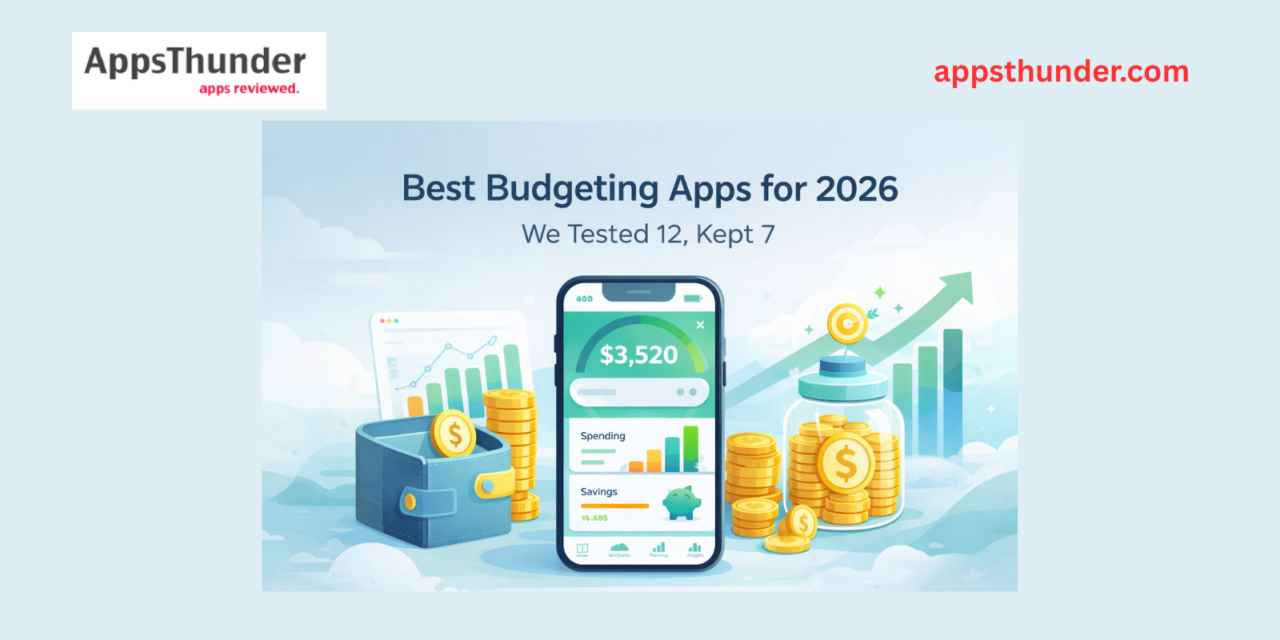
Budgeting apps have a 73% abandonment rate within the first month. The reason isn’t willpower — it’s that most apps are built around a system that doesn’t match how the person using them actually thinks about money.
Introduction
There are now more budgeting apps in the App Store than at any point in history. Most of them share the same core features — bank sync, category tracking, spending charts — and most of them will be deleted before the trial ends. We spent six weeks testing twelve of the most-used budgeting apps across different financial situations: salaried employees, freelancers, couples, and people actively paying down debt. Seven made the cut. Here’s exactly what we found, who each app is right for, and which one you should download today.
The 7 Best Budgeting Apps for 2026
1. YNAB (You Need A Budget)
- Zero-based budgeting: every dollar gets a job before it’s spent
- Real-time sync across web, iOS, and Android
- Goal tracking for debt payoff, savings, and irregular expenses
- Age of Money metric shows how many days your money ‘ages’ before spending
- Direct import from 12,000+ financial institutions
- Loan calculator and net worth tracker built in
- Award-winning customer support and free live workshops
- 34-day free trial — no credit card required
Best For: Freelancers, people paying off debt, and anyone who wants maximum control. YNAB’s philosophy requires active engagement — it rewards those who check it regularly.
Pricing: $14.99/month or $99/year. College students get 12 months free.
Limitation: Steep learning curve in the first week. The zero-based philosophy is a mindset shift that some users never click with.
2. Copilot — The most beautiful budgeting app ever made
- AI-powered transaction categorisation that learns your habits
- Clean, Apple-design-quality interface (iOS only)
- Automatic bank sync with read-only access
- Custom budget rules and category overrides
- Investment account tracking alongside spending
- Retroactive rule-setting: categorise future transactions based on past patterns
- Merchant logo matching and smart naming
- Family sharing for up to 5 members
Best For: iPhone users who want a premium, low-effort experience and are willing to pay for beautiful design. If you want to check your budget in 30 seconds and move on, Copilot is built for you.
Pricing: $13.99/month or $107.99/year. 30-day free trial.
Limitation: iOS only — no Android app. Lacks the granular control of YNAB for power users.
3. PocketGuard — The simplest answer to ‘Can I afford this?’
- In My Pocket calculation: shows what’s safe to spend after bills, goals, and necessities
- Automatic categorisation of recurring bills
- Debt payoff plan with payment scheduling
- Subscription tracker identifies recurring charges
- Bill negotiation service (US only) — PocketGuard negotiates lower rates on your behalf
- Custom spending limits per category
- Net worth overview
- Available on iOS and Android
Best For: Beginners who want a single number telling them what they can safely spend. Anyone who finds YNAB too complex will immediately understand PocketGuard.
Pricing: Free (with ads and limited features); PocketGuard Plus $12.99/month or $74.99/year.
Limitation: Free tier is heavily limited. Bill negotiation service only works in the US.
4. MoolaCon — Real-time spending readiness — a genuinely fresh approach
- Five-level Spending Readiness Condition updated minute-by-minute
- Compares planned vs actual spending in real time — no complex setup required
- Countdown timer shows exactly how long to return to a higher readiness level if spending stops
- Tracks scheduled and variable expenses separately
- Projects year-end surplus or deficit based on current behaviour
- Patent-pending methodology — no other app uses this framework
- Clean, distraction-free interface — no cluttered charts or category breakdowns
- iOS app with App Store availability
Best For: People who want a simple, objective indicator of budget health without setting up complex category budgets. Especially strong for those who’ve tried traditional apps and abandoned them.
Pricing: Free on the App Store (initial release).
Limitation: Expense-focused in its initial release — income tracking comes in a future update.
Download MoolaCon: MoolaCon on the App Store | Read our full review: MoolaCon Review
5. Monarch Money — The best app for couples and households
- Built-in collaboration — both partners see shared finances with individual privacy controls
- Household budget with multi-account overview
- Custom dashboards with drag-and-drop widgets
- Investment and net worth tracking
- Recurring transaction management
- Financial goal setting with progress visualisation
- No ad-based revenue — subscription only, privacy-first
- Available on iOS, Android, and web
Best For: Couples and households managing money together. The collaboration features and shared visibility make it the strongest option for joint finances by a significant margin.
Pricing: $14.99/month or $99.99/year. 7-day free trial.
Limitation: Pricier than some competitors. Overkill for single users who don’t need collaboration features.
6. Goodbudget — Envelope budgeting without the paper
- Digital envelope budgeting method — allocate money to virtual envelopes before spending
- Sync across multiple devices without requiring bank account connections
- Manual transaction entry for full privacy
- Debt tracking and payoff planner
- Shared envelopes for couples and roommates
- Report generation for spending analysis
- Available on iOS, Android, and web
- No bank account connection required — privacy-first by design
Best For: Privacy-conscious users who prefer manual entry. Anyone who likes the envelope budgeting method but doesn’t want physical cash. Ideal for people whose banks don’t support open banking integrations.
Pricing: Free (10 envelopes, 1 account); Goodbudget Plus $10/month or $80/year.
Limitation: Manual entry requires daily discipline. Not ideal for anyone who wants automatic bank sync.
7. Rocket Money (formerly Truebill) — The subscription killer
- Identifies and cancels unwanted subscriptions on your behalf
- Automatic bill negotiation — Rocket Money negotiates lower bills for a success fee
- Spending categorisation and budget tracking
- Credit score monitoring (US)
- Net worth tracking
- Savings account with automated transfers
- Rent reporting to credit bureaus (US)
- Available on iOS and Android
Best For: Anyone who suspects they’re paying for subscriptions they’ve forgotten about — which is almost everyone. Rocket Money’s subscription scanner typically finds £50–£200 of unnecessary recurring charges in the first scan.
Pricing: Free basic; Premium $6–$12/month (pay-what-you-want model). Bill negotiation takes 30–60% of first year’s savings as a fee.
Limitation: Bill negotiation success fee can be expensive for high-value bills. Core budgeting features are less refined than YNAB or Copilot.
Head-to-Head: YNAB vs. Copilot vs. PocketGuard
| Criteria | YNAB | Copilot | PocketGuard |
| Budgeting method | Zero-based (proactive) | Automated tracking (reactive) | Safe-to-spend calculation |
| Platforms | iOS, Android, Web | iOS only | iOS, Android |
| Bank sync | Yes — 12,000+ institutions | Yes — automatic | Yes — automatic |
| Monthly cost | $14.99 | $13.99 | Free / $12.99 |
| Best for | Debt payoff, control freaks | iPhone users, low effort | Beginners, simplicity |
| Learning curve | High — requires daily use | Low — mostly automatic | Very low — one number |
| Free trial | 34 days | 30 days | Free tier available |
Which Budgeting App Should You Choose?
- You’re paying off debt and want full control: YNAB. The zero-based system forces intentionality that accelerates debt payoff faster than any other approach here.
- You want something that works automatically on iPhone: Copilot. Set it up once, check it weekly. The AI categorisation is the most accurate of any app we tested.
- You’re a complete beginner: PocketGuard. One number — ‘In My Pocket’ — tells you everything you need to know.
- You want real-time spending status without complex setup: MoolaCon. The readiness system is unlike anything else in this list.
- You manage finances with a partner: Monarch Money. Nothing else comes close for household collaboration.
- You’re drowning in forgotten subscriptions: Rocket Money. Run the subscription scan first — the savings often pay for the premium subscription many times over.
Frequently Asked Questions
What is the best free budgeting app in 2026?
PocketGuard’s free tier is the most genuinely useful free budgeting app — it calculates your safe-to-spend amount automatically and tracks subscriptions. MoolaCon is also free at launch and delivers real-time spending readiness without requiring complex setup. Goodbudget’s free tier works well for manual envelope budgeting across up to 10 categories.
Is YNAB worth $14.99 a month?
For the right user, yes — and the maths is straightforward: YNAB reports new users save an average of $600 in the first two months. At $14.99/month, that’s a 400% return. The qualification is ‘for the right user’ — YNAB requires daily engagement with the zero-based methodology. People who want a passive ‘set and forget’ experience will not get value from the subscription.
Which budgeting app works best for couples?
Monarch Money is purpose-built for joint finances and handles household budgeting, shared accounts, and individual privacy better than any competitor. Honeydue is a simpler (and free) alternative for couples who just want to see each other’s balances and split bills, without the comprehensive budget-building features Monarch offers.
Do budgeting apps really work?
Yes — but only when matched to how you actually manage money. Research consistently shows that visibility into spending changes behaviour. People using budgeting apps save more than those who don’t. The failure point is almost always picking the wrong type of app (too complex, too manual, wrong platform), not budgeting itself. Our guide on how to choose a budgeting app walks through the selection process.
Are budgeting apps safe for banking information?
Reputable budgeting apps use read-only open banking connections — they can see your transaction history and balance but cannot initiate transfers or access your login credentials. Apps like YNAB, Copilot, and MoolaCon use bank-grade 256-bit encryption. The real risk is with obscure free apps that monetise by selling data — always check the privacy policy before connecting any financial account.
Conclusion
The best budgeting app is always the one you’ll actually use for longer than a week. YNAB and Copilot lead the field in power and experience respectively, while PocketGuard and MoolaCon make budgeting accessible to anyone who’s been intimidated by complex systems. Download your top choice today, connect your main spending account, and give it a genuine 30-day run before judging the results.
Not sure where to start? Our guide on how to choose the right budgeting app matches the right app to your exact situation in five steps.