Both apps have millions of subscribers. Both cost around $70/year. Both are recommended by therapists and featured in Apple’s health campaigns. Choosing between them based on marketing copy alone is nearly impossible — because the marketing copy for each sounds identical. The real difference is in philosophy, and it determines which one you’ll use consistently and which one you’ll abandon after two weeks.
The Fundamental Difference
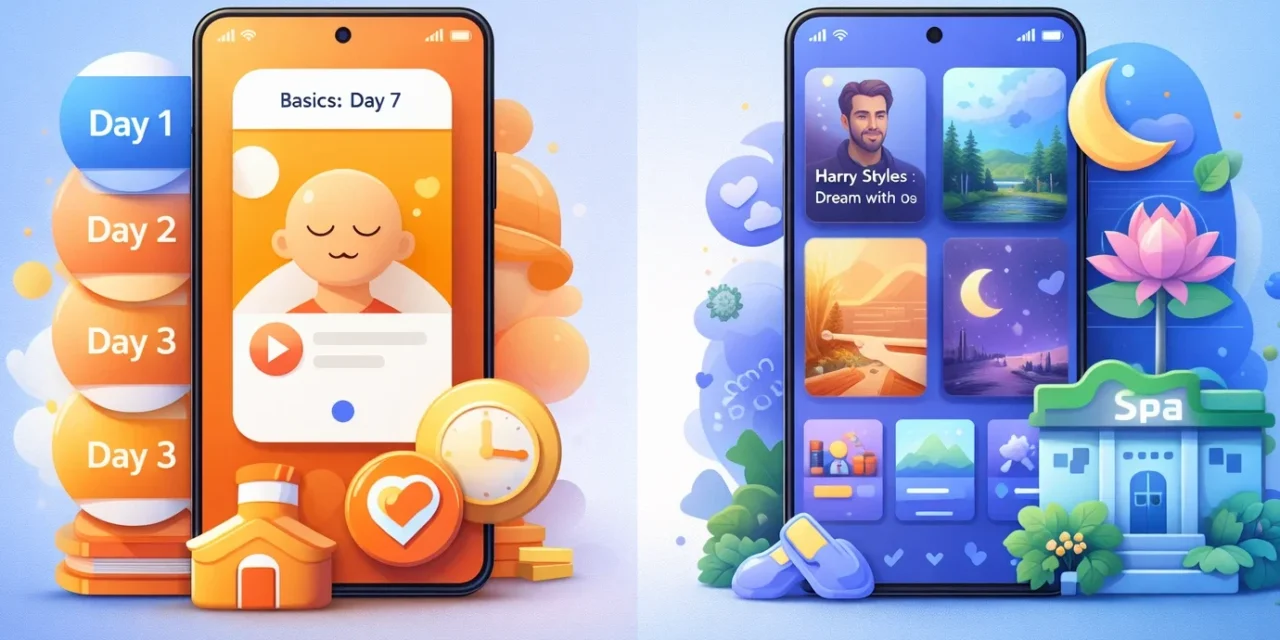
Headspace is structured. It teaches meditation as a skill through sequential courses. You start at the beginning, progress through sessions, and build understanding over time. Think of it as a meditation school.
Calm is atmospheric. It’s a library of content you browse and dip into — sleep stories, breathing exercises, music, nature sounds, and meditation sessions you can pick in any order. Think of it as a relaxation spa.
This difference shapes the entire experience. Headspace rewards commitment and creates a learning arc. Calm rewards flexibility and meets you wherever you are emotionally on any given day.
Feature-by-Feature Comparison
| Feature | Headspace | Calm |
| Teaching approach | Structured, progressive courses | Browse-and-pick content library |
| Best for | Building a meditation habit from scratch | Stress relief, sleep, flexible use |
| Meditation style | Primarily mindfulness (Andy Puddicombe method) | Multiple styles: mindfulness, breathwork, body scan |
| Sleep content | Sleep by Headspace (Sleepcasts, wind-down exercises) | Sleep Stories (celebrity narrators), sleep music |
| Celebrity content | Minimal | Extensive (Harry Styles, Matthew McConaughey, LeBron James) |
| Kids content | Headspace for Kids — 5 courses by age group | Calm Kids — stories, meditations, sleep |
| Focus/work content | Focused mode — music designed for concentration | Focus music, Calm Body movement sessions |
| Free tier | Limited (3 courses, some content) | Very limited (7-day trial then paywall) |
| Price (annual) | ~$69.99/year or $12.99/month | ~$69.99/year or $14.99/month |
| Family plan | Up to 6 members, additional cost | Up to 6 members, same subscription |
| Apple Watch | Breathwork, single-tap sessions | Breathing exercises, daily calm |
| Clinical backing | Multiple peer-reviewed studies on Headspace efficacy | Fewer published studies; growing research base |
| Offline access | Yes — download sessions for offline use | Yes — download sessions for offline use |
Who Should Choose Headspace
Headspace is the stronger choice if you’re a meditation beginner who wants structured guidance. Its Basics course — 10 guided sessions that build on each other — is one of the best-designed meditation introductions available. Research published in peer-reviewed journals (Frontiers in Psychology, JMIR Mental Health) has examined Headspace specifically and found measurable reductions in stress, burnout, and mind-wandering after as few as 10 sessions.
The progression system matters for consistency. Knowing you’re on Day 7 of a 30-day course creates a small but meaningful commitment anchor. Headspace users who complete at least one full course show significantly higher 90-day retention than users who sample sessions randomly — which reflects the app’s design intent.
Also choose Headspace if you use it for work-focused use cases: the Focus mode content (ambient music designed for cognitive tasks) is genuinely useful during deep work sessions, and the work-specific courses (managing stress at work, difficult conversations, dealing with burnout) are more targeted than Calm’s equivalents.
Who Should Choose Calm
Calm is the stronger choice if you already have some meditation experience or if sleep improvement is your primary goal. The Sleep Stories feature — long-form bedtime stories narrated by celebrities including Harry Styles, Matthew McConaughey, and others — is genuinely distinctive. Nothing Headspace offers in the sleep category matches it for variety and production quality.
Calm is also better for users who resist routine. If the idea of being told to start from lesson one feels restrictive — if you want to pick a 10-minute breathwork session on Monday, a sleep story on Tuesday, and a body scan on Thursday — Calm’s content library accommodates that more naturally.
The Calm Body video series (movement and stretching) and Daily Calm (a new 10-minute meditation released every day) add flexibility that Headspace’s structured approach doesn’t match. For users who want a broader wellness companion rather than a meditation teacher specifically, Calm wins.
The Research Picture
Headspace has more published efficacy research than Calm. A 2018 study (Frontiers in Psychology) found Headspace reduced stress by 14% over 10 days. A workplace study found reduced aggression and improved focus after 8 weeks of use. These are genuine controlled studies, not app-funded press releases.
Calm has funded research but has fewer peer-reviewed independent studies specifically on its app. This doesn’t mean Calm doesn’t work — general meditation research is substantial and applies broadly — but Headspace can point to its specific product being tested.
For users making a decision partly on evidence of effectiveness, Headspace’s research profile is stronger.
Free Tier Reality
Neither app is meaningfully free. Headspace’s free tier offers the first three sessions of the Basics course and a small selection of other content — enough to experience the app’s style but not enough for ongoing use. Calm’s free tier is even more restricted: essentially a 7-day free trial, after which almost all content is paywalled.
If cost is a primary constraint, Insight Timer is the strongest free alternative: it offers thousands of free guided meditations from independent teachers, with a relatively small premium tier for structured courses.
Frequently Asked Questions
Is Headspace or Calm better for anxiety?
Both apps include anxiety-focused content. Headspace has structured courses specifically for anxiety management with a clear progression. Calm’s breathing exercises (4-7-8 breathing, box breathing) are particularly effective for acute anxiety moments — quick interventions you can access on-demand. For chronic anxiety management, Headspace’s structured approach may build more durable habits; for in-the-moment relief, Calm’s flexibility wins.
Can I use Headspace or Calm offline?
Yes, both apps support offline use. You can download individual sessions and packs to your device for access without an internet connection. This is useful for plane travel, commutes with spotty reception, or users who prefer to minimise app data usage.
Which is better for kids?
Headspace for Kids has five course tracks organised by age group (0-2, 3-5, 6-8, 9-12, 13+ teens) with animated content for younger children. Calm Kids offers meditation and sleep stories specifically narrated for children. Both are included in the main subscription. Headspace’s age-structured approach is more educational; Calm’s sleep stories for kids are particularly highly rated by parents for bedtime use.
Do meditation apps actually work?
The broader research on mindfulness meditation is robust — multiple meta-analyses confirm reductions in anxiety, stress, and depressive symptoms from consistent meditation practice. App-based meditation has been specifically studied: Headspace has published peer-reviewed research showing measurable results from its courses. The key qualifier across all studies is consistency — occasional use produces minimal results; daily practice over 4+ weeks produces the documented benefits.
Is there a free alternative to Headspace and Calm?
Insight Timer is the best free alternative. It hosts thousands of free guided meditations from teachers worldwide, covering mindfulness, breathwork, yoga nidra, and sleep. The free version is genuinely usable — not a trial. Ten Percent Happier also offers a free tier with a limited course selection. For structured, beginner-friendly courses specifically, neither free alternative matches Headspace’s quality — but Insight Timer provides significantly more content than either app’s free tier.
The Verdict
Choose Headspace if: you’re new to meditation, want structured skill-building, prefer evidence-backed courses, or use it primarily for work focus.
Choose Calm if: you already meditate occasionally, sleep improvement is your primary goal, you want content flexibility, or you’re paying for Sleep Stories specifically.
Both apps offer 7-day free trials. The most reliable way to choose: try Headspace’s Basics course for one week, then Calm’s sleep stories and Daily Calm for one week. The one you look forward to opening is the right answer.