
Introduction
Yoga has grown from a niche wellness practice to a mainstream global industry. Yoga studios are popping up everywhere—from major cities to small towns—and both in-person and virtual classes are on the rise. The “Yoga Studio Platform” / Yoga Studio Software market was valued around USD 120 million in 2023 and is expected to grow to about USD 320 million by 2032, with a CAGR of ~11-12 %. Dataintelo As more studios seek better scheduling, client engagement, membership management and digital class offerings, the demand for robust software solutions continues to escalate.
Who Uses Yoga Studio Software & What Problems They Face
The main users are yoga studio owners and managers, fitness instructors offering yoga, wellness centres that include yoga, virtual yoga class providers, and multi-location studios. They face challenges like:
- Managing class schedules, cancellations, wait-lists, and avoiding conflicts or double-bookings.
- Handling membership or drop-in clients, subscription vs one-time payment models.
- Processing payments, tracking attendance, handling no-shows and refunds.
- Engaging clients: reminding them, promoting classes or workshops, offering virtual sessions.
- Managing staff / instructor schedules, spaces (rooms or studios), and equipment.
- Reporting & analytics: understanding which classes are popular, revenue per class/instructor, retention rates etc.
Key Feature Areas of Yoga Studio Software
Here are the core feature sets/modules that yoga studio software should ideally provide, with what they do:
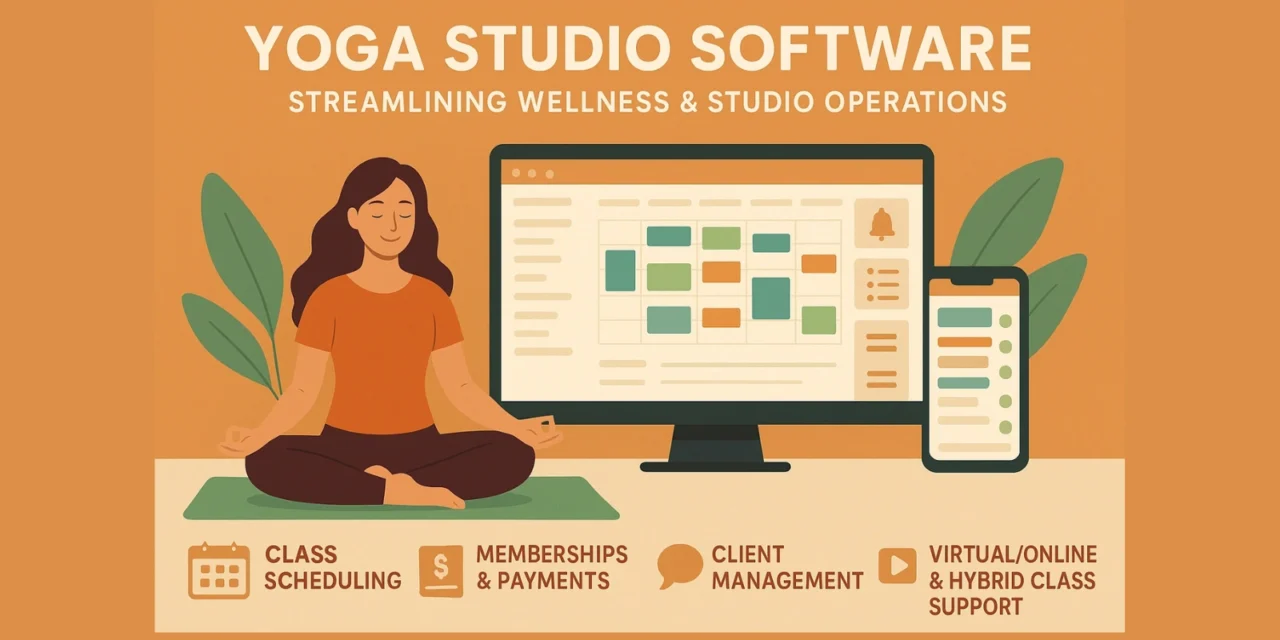
Class Scheduling & Booking Management
These features help both studios and clients see what’s coming up, book easily, and manage capacity or wait-lists.
- Online class booking portals; recurring classes and workshop scheduling.
- Wait-lists, drop-in bookings, cancellation & rescheduling.
- Studio room/space allocation; instructor assignment.
- Calendar views, class occupancy tracking.
Memberships, Payments & Financial Management
Critical for monetization and keeping operations running.
- Membership/subscription plans, packages, drop-in rates.
- Recurring billing; discounts, trials or promotions.
- Payment gateways integration; handling refunds, no-shows etc.
- Financial reports: revenue per class, per instructor, outstanding payments.
Client / Member Management & Communication
Ensuring clients feel engaged and supported.
- Member profiles (contact, attendance history, preferences).
- Automated reminders via SMS/email, class notifications.
- Client app or portal where clients can view schedules, make cancellations/bookings.
- Feedback collection, reviews, community features.
Virtual/Online & Hybrid Class Support
Especially since more yoga studios offer livestream or recorded classes.
- Integration with video conferencing / streaming tools.
- Upload / host on-demand videos or class recordings.
- Hybrid scheduling (both physical and virtual class options).
Instructor / Staff & Studio Resource Management
To optimize the human and physical resources.
- Staff & instructor scheduling; tracking availability.
- Studio/room or space booking; equipment or props inventory if needed.
- Staff payroll or instructor pay-out tracking depending on classes taught.
Reporting, Analytics & Insights
Data helps studios understand business health and grow.
- Dashboard views: attendance trends, popular classes, revenue vs cost.
- Retention & churn rates of members.
- Analysis of no-show rates, peak times, occupancy per class.
- Forecasting to plan class schedules or staffing.
Integrations, Mobile & User Experience Considerations
To make things smoother for both studio owners and clients.
- Mobile apps for clients to book/view schedules; for staff/owners to manage on the go.
- Integrations with calendar apps, payment gateways, marketing tools (email/SMS), maybe POS for merchandise.
- UI/UX that is clean, intuitive; support for local payments / currencies / languages if needed.
Key Buying Design Considerations
When a studio is evaluating software, here are things to look out for:
- Flexibility in pricing models (subscription, per member, per class) and transparent pricing.
- How well virtual/hybrid functionality is supported (video streaming, on demand).
- Good mobile experience for both clients and administrators.
- Strong reporting tools; ability to export data.
- Ease of setup and support; is there a trial/demo? How is customer service.
- Customization or localization (language, currency, tax, local payment methods).
- Scalability: from a single studio to multiple locations, more instructors, more classes.
- Security and data privacy (user data, payment data etc.).
Market Size & Growth Trends
- The Yoga & Pilates studio software market was valued at approximately USD 2.6 billion in 2023, and is projected to reach about USD 7.3 billion by 2033, growing at ~11.4 % CAGR.
- Segment-specific: the scheduling software portion is also growing fast: valued at around USD 0.22 billion in 2024, expected to reach ~USD 0.56 billion by 2033.
Top Apps / Tools in the Market
Here are some well-known yoga studio software tools:
- Mindbody – Powerful, broad platform with scheduling, payment, virtual/hybrid class support.
- WellnessLiving – Class scheduling, client apps, retention tools, marketing automation.
- Wellyx – Real-time class scheduling, booking, studio space management, client self-booking.
- The Studio Director – Payment management, reports, client list, staff tracking etc.
- SimplyBook.me – Flexible booking system, good for workshops/events, classes.
- Vagaro – Popular for salons & fitness studios too; includes yoga class support.
Highlight: Your Product / ChurchCMS-like (if this is your product)
(If you have your product’s details, insert here—features, what differentiates it, strengths, pricing etc.)
For example, suppose you have a product “YogaCMS.app” (analogy to ChurchCMS) or your own yoga-studio software; you might highlight:
- How your software handles public vs member access (guest view vs member dashboard).
- Mobile app for clients to view schedules, book, get reminders.
- Virtual class integration.
- Ease of use & setup; branded experience.
- Transparent pricing; free trial etc.
End Note: Upcoming Challenges & Trends
Some emerging trends and challenges to watch out for:
- Increasing demand for hybrid & online yoga offerings, including livestream and video-on-demand.
- Use of AI/ML for class demand forecasting, personalised class suggestions, managing no-shows.
- Better client engagement tools (gamification, loyalty, community building).
- Mobile experience will become more critical as clients expect apps or smooth mobile site usage.
- Data privacy, payments security, compliance will be more important as usage scales.
- Localization: studios in different countries need local payment methods, language support, currency, tax compliance.
Despite competition, the outlook is positive. Studios that adopt good software gain in efficiency, client engagement, scheduling and financial clarity—and are better positioned to grow sustainably.