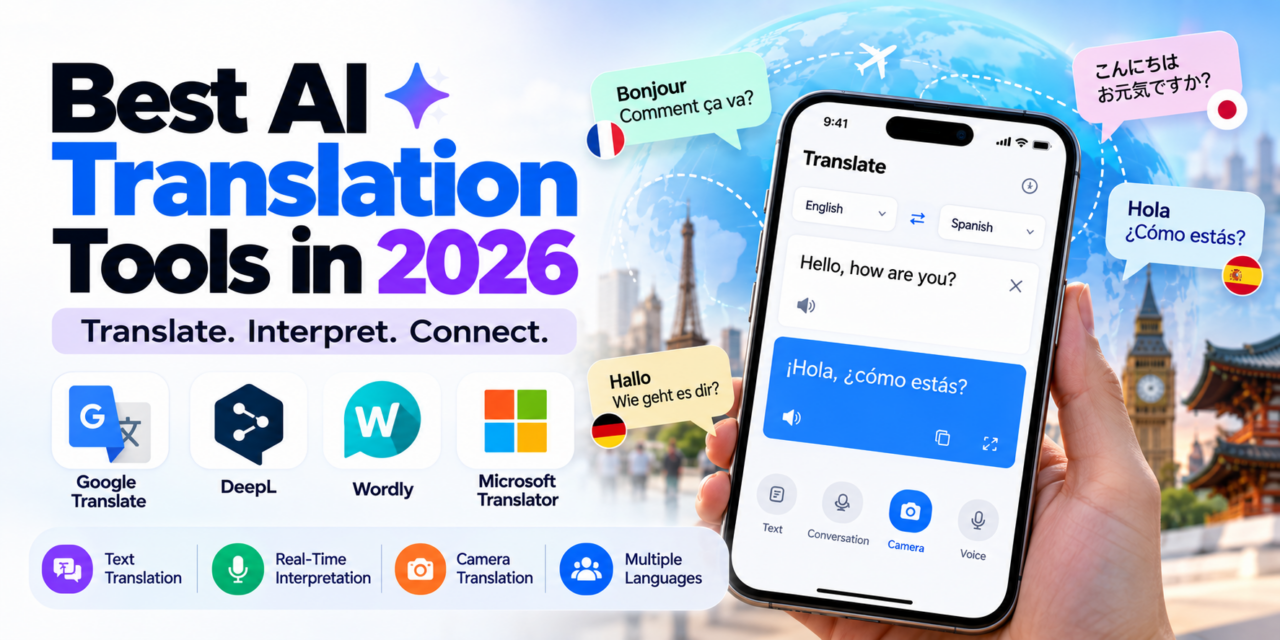
A language barrier remains one of the most genuinely solvable problems AI has actually addressed well, and translation tools have matured from clunky, literal word-for-word conversion into genuinely natural, contextually aware output that reads like it was written by a fluent speaker rather than a machine. The category splits into distinct approaches worth understanding: text translation tools optimized for accuracy and nuance, and real-time spoken interpretation tools built for live conversation. Here’s a look at what’s worth using this year.
Google Translate
Google Translate remains the most widely used and broadly capable translation tool available, supporting more than 130 languages with genuinely useful real-time camera translation that overlays translated text directly onto a photographed sign or menu. Its conversation mode enables real-time spoken translation between two people speaking different languages, taking turns speaking into the same phone, and its offline language pack downloads let travelers translate without needing an active internet connection in areas with poor signal. For anyone who wants the broadest possible language coverage and the most universally available translation tool, it remains the safest default choice.
View on Play Store | View on App Store
DeepL
DeepL has built a genuinely strong reputation specifically for translation quality and naturalness, with independent comparisons and professional translators consistently noting its output reads more fluently and contextually accurate than competitors for supported language pairs, particularly among European languages. Its formal and informal tone options let users match a translation’s register to the actual context, a business email versus a casual message to a friend, rather than producing a single generic tone regardless of situation. For anyone specifically prioritizing translation quality and natural phrasing over sheer language coverage breadth, it remains one of the most respected options available.
View on Play Store | View on App Store
Wordly
Wordly specializes specifically in real-time interpretation for live events and meetings, providing simultaneous spoken translation for conferences, presentations, and multi-language business meetings where attendees speak several different languages at once. Its ability to support dozens of simultaneous language streams for a single live event makes it particularly valuable for genuinely multilingual conferences or international business gatherings where hiring individual human interpreters for every language pair would be prohibitively expensive. For organizations hosting genuinely multilingual live events specifically, it remains one of the most purpose-built tools in the category.
Microsoft Translator
Microsoft Translator offers genuinely strong real-time conversation translation with support for group conversations involving multiple people speaking different languages simultaneously, each seeing the conversation translated into their own preferred language on their own device. Its deep integration with Microsoft’s broader productivity suite makes it a natural fit for organizations already standardized on Microsoft 365 for business communication and collaboration. For multilingual team meetings or group conversations specifically needing more than a simple two-person exchange, it remains one of the stronger options for that specific group-conversation use case.
View on Play Store | View on App Store
Choosing between these four largely comes down to whether the need is broad text translation, natural-sounding output, or live spoken interpretation. Anyone wanting the broadest possible language coverage and reliable camera-based translation for signs and menus while traveling should default to Google Translate, while users specifically prioritizing translation quality and natural phrasing for professional or written communication should invest in DeepL. Organizations hosting genuinely multilingual live events or conferences should evaluate Wordly’s simultaneous interpretation capability, and teams needing real-time group conversation translation across several languages at once should consider Microsoft Translator.
Conclusion
AI translation and interpretation tools have made genuine, measurable progress toward eliminating language barriers as a practical daily obstacle, whether for a quick vacation menu translation or a genuinely complex multilingual business meeting. Whichever of these four ends up fitting a specific communication need, the underlying payoff remains consistent: understanding and being understood, regardless of which language the other person actually speaks.