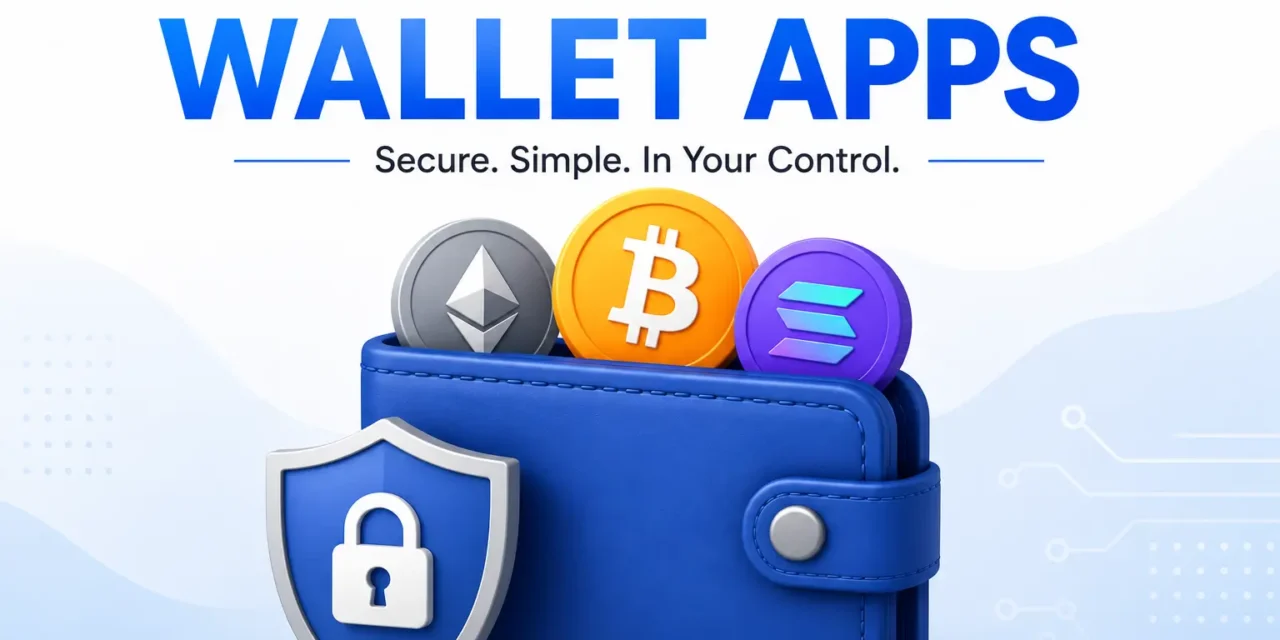
Choosing the right crypto wallet app in 2026 is a more consequential decision than choosing most other apps. The wallet you use determines how much control you have over your assets, what blockchains and tokens you can hold, and crucially how well protected your funds are from theft and loss. This review covers the five best crypto wallet apps available on iOS and Android, with an honest assessment of the security model and trade-offs of each.
Understanding Wallet Types Before You Choose
Before comparing specific apps, the most important distinction is between custodial and non-custodial wallets. A custodial wallet – like a wallet built into an exchange app – means the exchange holds your private keys and therefore your crypto. Non-custodial wallets give you direct control of your private keys, which means the crypto is truly yours but also means you are fully responsible for keeping those keys safe.
The phrase ‘not your keys, not your coins’ remains as relevant in 2026 as it has ever been. For significant holdings, a non-custodial wallet or hardware wallet solution provides substantially better security than keeping funds on an exchange.
1. Coinbase Wallet – Best for Beginners
Coinbase Wallet is a non-custodial wallet that separates your self-custody assets from your Coinbase exchange account. It supports Ethereum, Solana, and all EVM-compatible chains, along with thousands of ERC-20 and SPL tokens. The DeFi browser integration allows connecting to decentralised applications directly from the wallet.
The user experience is the most polished of any non-custodial wallet in 2026, which makes it the best entry point for users who are new to self-custody. The connection to the Coinbase ecosystem provides helpful context for users who also have a Coinbase exchange account. The biometric authentication and cloud-encrypted recovery phrase backup option reduce the risk of permanent loss from forgotten credentials.
Download Coinbase Wallet on the Play Store or App Store. Visit www.coinbase.com/wallet.
2. MetaMask – Best for Ethereum and DeFi
MetaMask remains the most widely used Ethereum and EVM-compatible chain wallet in 2026. Its near-universal acceptance across decentralised exchanges, DeFi protocols, NFT platforms, and Web3 applications makes it the essential wallet for anyone actively participating in the Ethereum ecosystem. The mobile app and browser extension work in coordination, allowing seamless switching between phone and desktop.
The 2026 update improved the gas fee estimation significantly – the automatic fee recommendations now accurately predict confirmation time and rarely result in transactions being stuck in the mempool. The token swap feature within the app has also improved, with better rate sourcing across decentralised liquidity pools.
Download MetaMask on the Play Store or App Store. Visit www.metamask.io.
3. Trust Wallet – Best Multi-Chain Wallet
Trust Wallet supports over one hundred blockchains and ten million-plus tokens in 2026, making it the most comprehensively multi-chain wallet available on mobile. If you hold a diverse range of crypto assets across multiple blockchains – Bitcoin, Ethereum, Solana, BNB Chain, Polygon, Avalanche, and others – Trust Wallet provides the clearest unified view and management interface.
The built-in Web3 browser gives access to DeFi applications across all supported chains. The NFT management features allow viewing, sending, and connecting NFTs from multiple chains in a single interface. Trust Wallet is owned by Binance but operates with its own team and product direction – the Binance connection provides resources but the product has maintained its own identity.
Download Trust Wallet on the Play Store or App Store. Visit www.trustwallet.com.
4. Ledger Live – Best for Hardware Wallet Users
Ledger Live is the companion app for Ledger hardware wallets – the Nano X and Nano S Plus – which are the most widely used hardware wallets for securing significant crypto holdings. The hardware wallet model keeps your private keys on a dedicated physical device that never connects to the internet, making it resistant to software-based attacks that compromise hot wallets.
The Ledger Live mobile app allows managing your Ledger hardware wallet from your phone via Bluetooth pairing with the Nano X. You can view balances, send and receive crypto, and interact with DeFi applications while keeping the keys on the hardware device. For users with significant holdings who want the security of hardware wallet custody with the convenience of mobile management, this combination is the best security architecture available in 2026.
Download Ledger Live on the Play Store or App Store. Visit www.ledger.com for hardware wallet purchasing.
5. Exodus – Best for Desktop-Mobile Syncing
Exodus is a multi-asset wallet with excellent desktop applications for Windows, Mac, and Linux that sync seamlessly with the iOS and Android mobile apps. The portfolio tracking features – showing the value of your entire portfolio in your local currency with price charts and performance history – are the best integrated into any self-custody wallet app in 2026.
The built-in crypto exchange within Exodus allows swapping between supported assets without leaving the wallet app. The customer support team for Exodus is human-staffed and responsive, which is notable in a category where most non-custodial wallets provide limited support resources given the self-custody philosophy.
Download Exodus on the Play Store or App Store. Visit www.exodus.com.
Crypto Wallet Security Best Practices in 2026
Regardless of which wallet you choose, these practices are essential. Write your seed phrase on paper and store it in a physically secure location – never photograph it or store it digitally. Enable biometric authentication on your mobile wallet app. For holdings above five hundred dollars, consider a hardware wallet from Ledger or Trezor. Never share your seed phrase with anyone, including people claiming to represent the wallet company’s support team