
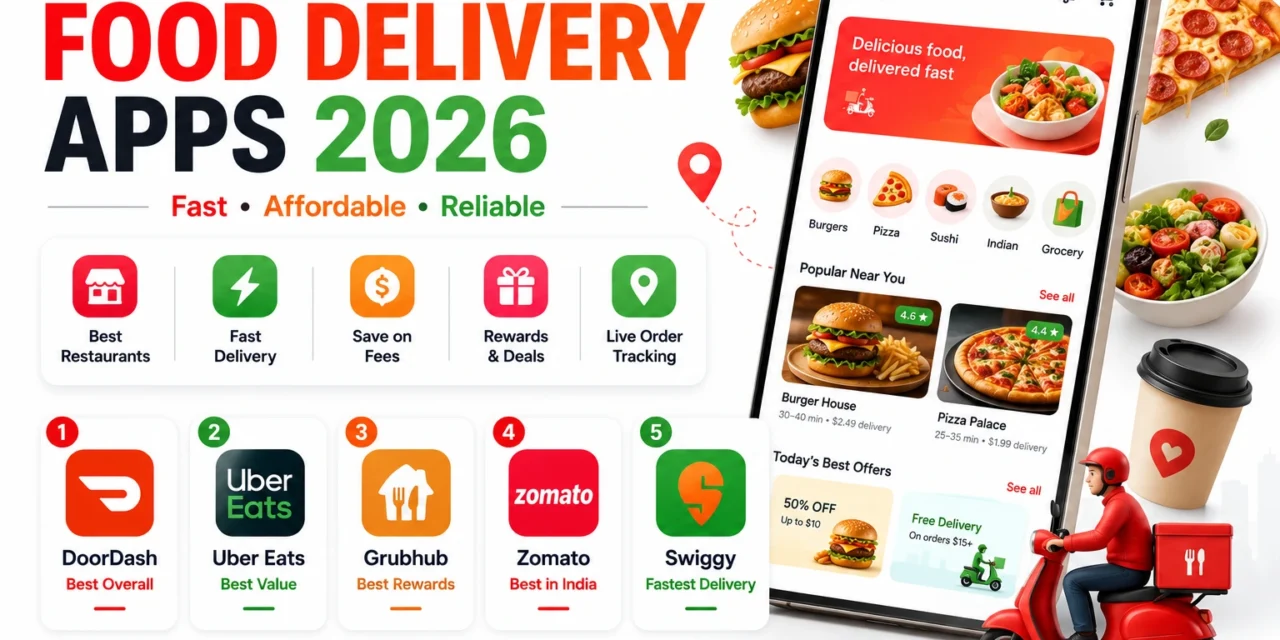
Food delivery fees have become increasingly complex in 2026 – delivery fees, service fees, small order fees, and the cost difference between in-restaurant and in-app menu prices all combine to make the actual cost of delivery significantly higher than the listed food price. Understanding which app offers the best genuine value requires looking beyond the headline delivery fee to the total cost of a typical order. These five apps were compared using identical test orders across multiple cities and restaurant types.
DoorDash – Best Restaurant Selection in the US
DoorDash maintains the largest restaurant network in most US markets in 2026, giving it an advantage simply through choice availability even when the per-order cost is comparable to competitors. The DashPass subscription at nine dollars and ninety-nine cents per month eliminates delivery fees on qualifying orders and is the best value subscription if you order more than twice per month.
In testing across identical orders, DoorDash’s menu prices were consistently five to fifteen percent higher than in-restaurant prices, which is standard across the industry but worth knowing when comparing the displayed total to what you would pay walking into the restaurant directly. The delivery time accuracy has improved significantly in 2026, with actual delivery times matching the app’s estimate within a five-minute margin in the large majority of orders tested.


Uber Eats – Best for Combined Trip and Delivery Needs
Uber Eats benefits from the broader Uber ecosystem – users who already have Uber One for ride-sharing discounts get delivery fee waivers as part of the same subscription, which makes it the most cost-effective option for users who also use Uber for transportation regularly. The restaurant selection is comparable to DoorDash in most major markets, with some regional variation in which platform has stronger restaurant partnerships.
The Uber Eats app interface in 2026 has improved its order tracking with more precise live driver location and accurate arrival predictions. The grocery and convenience store delivery integration within the same app provides additional utility beyond restaurant food that some competitors lack as a unified experience.
Grubhub – Best for Loyalty Rewards
Grubhub’s Grubhub+ subscription at nine dollars and ninety-nine cents per month includes the standard delivery fee waiver but adds a meaningful points-based rewards programme that returns cash back on every order, which DoorDash and Uber Eats do not match at an equivalent subscription cost. For users who order frequently from the same restaurants, the points accumulation can offset a meaningful percentage of total spending over time.
The restaurant selection in Grubhub’s strongest markets – particularly the northeastern United States where the company originated – is excellent, though coverage in some other regions lags behind DoorDash and Uber Eats. The perks programme offering free items from partner brands adds occasional additional value beyond the core delivery service.
Zomato – Best for Indian Food Delivery
Zomato remains the most comprehensive food delivery platform for the Indian market in 2026, with restaurant coverage extending well beyond major cities into smaller towns where competing services have limited presence. The Zomato Gold membership at one hundred and ninety-nine rupees per month provides delivery fee waivers and exclusive restaurant discounts that frequent users find genuinely valuable.
The app’s restaurant rating and review system remains the most trusted source for discovering quality restaurants in Indian cities, and the integration of dine-in table booking alongside delivery gives Zomato a broader utility than pure delivery-focused competitors. Delivery time estimates have become significantly more accurate in 2026 following infrastructure improvements in the company’s logistics platform.
Swiggy – Best for Speed in Indian Metro Cities
Swiggy’s delivery speed in major Indian metro cities consistently outperforms Zomato in testing, with the platform’s investment in dark store infrastructure and delivery partner density paying off in measurably faster delivery times in cities including Bangalore, Mumbai, and Delhi. The Swiggy One membership combines food delivery benefits with the Instamart quick commerce service in a single subscription.
The integration between Swiggy’s food delivery and Instamart grocery delivery in a single app creates genuine convenience for users who want both services from one platform rather than managing separate apps. The customer service responsiveness for order issues has also improved noticeably in 2026 compared to previous years.
How to Genuinely Save Money on Food Delivery
Regardless of which app you choose, the most significant savings come from a few consistent habits. Order during off-peak hours when surge or peak pricing does not apply. Use a subscription service if you order more than twice monthly – the math almost always favours the subscription over paying individual delivery fees. Compare the same restaurant’s in-app menu prices against the actual in-restaurant prices before ordering, since the markup varies significantly between restaurants. Group orders with roommates or colleagues to spread the delivery fee across more food and meet minimum order thresholds more easily.
Which App Should You Choose
US-based users without strong subscription loyalty: DoorDash for the broadest selection. US-based users who also use ride-sharing: Uber Eats for combined subscription value. US-based users who value loyalty rewards: Grubhub. Indian users in smaller cities and towns: Zomato for the broadest coverage. Indian users in major metros who prioritise speed: Swiggy.