
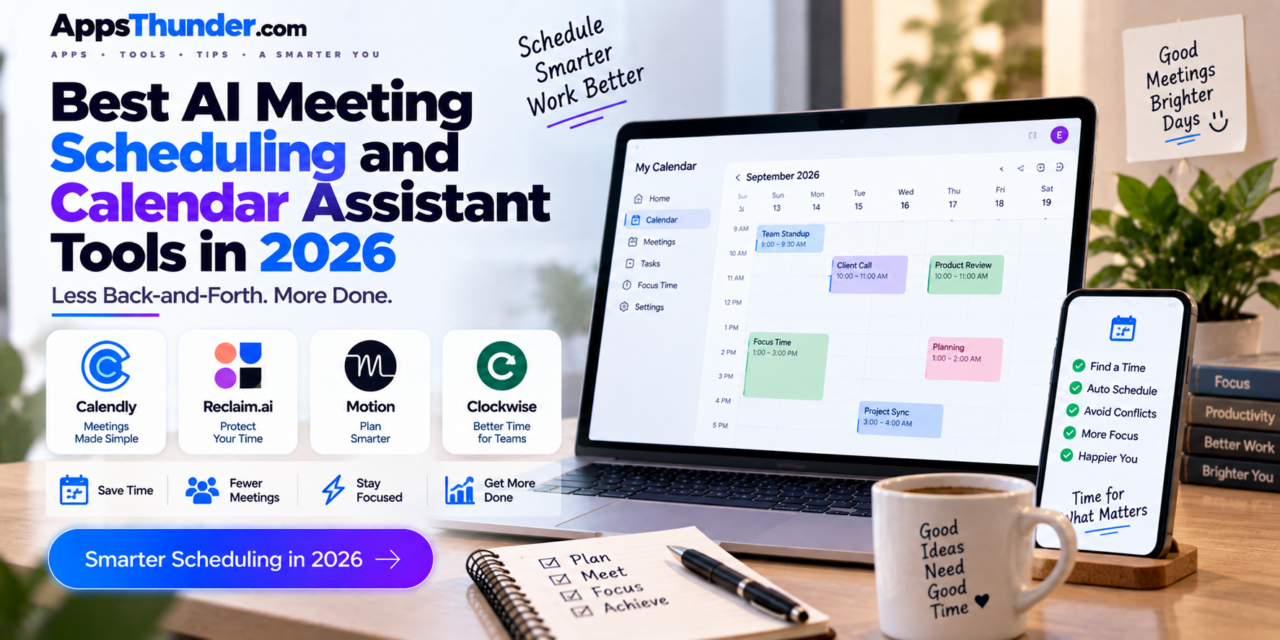
The email back-and-forth of proposing a time, getting a counter-proposal, and settling on a meeting slot remains a genuinely persistent time drain for busy professionals, and AI scheduling assistants have matured considerably in 2026 at eliminating that friction entirely. The strongest tools now go well beyond simply sharing a booking link, actively negotiating across multiple people’s calendars, learning individual scheduling preferences over time, and handling the genuinely tedious logistics of rescheduling when something inevitably conflicts. Here’s a look at what’s worth using this year.
Calendly
Calendly remains the most widely adopted scheduling tool, letting users share a personalized booking link that automatically reflects real-time calendar availability, removing the need for any manual back-and-forth entirely for external meetings with clients or candidates. Its AI-powered features now include smart meeting type suggestions and automated buffer time recommendations based on actual usage patterns, helping users avoid the kind of back-to-back scheduling that leads to burnout. Its deep integration with virtually every major calendar and video conferencing platform makes it the safest default choice for anyone who regularly schedules external meetings across different organizations.
Reclaim.ai
Reclaim.ai takes a fundamentally different approach from a pure booking-link tool, actively managing an entire calendar by automatically protecting time for habits, focus work, and tasks alongside meetings, and intelligently rescheduling flexible events when a genuine conflict arises rather than requiring manual intervention every time. Its habit-scheduling feature treats recurring personal priorities, exercise, deep work blocks, regular one-on-ones, as genuine calendar citizens that get defended and rescheduled automatically rather than getting bumped the moment a new meeting request arrives. For anyone whose real scheduling problem is protecting focus time from constant meeting creep rather than simply booking external calls, it remains one of the more sophisticated options available.
Motion
Motion combines AI-powered scheduling with task and project management, automatically slotting tasks into open calendar time based on priority and deadline rather than requiring a user to manually decide when to work on each item. Its AI continuously re-plans a schedule throughout the day as new meetings or urgent tasks appear, dynamically shifting lower-priority work to make room without requiring manual rescheduling of an entire day’s plan. For users who specifically want scheduling and task management unified into a single, actively managed system rather than treating them as separate tools, it remains one of the most integrated options in the category.
Clockwise
Clockwise focuses specifically on team-wide calendar optimization, automatically consolidating fragmented meeting schedules across an entire team to create longer, uninterrupted blocks of focus time that a single-user tool can’t achieve alone. Its Focus Time feature actively works to defragment a team’s collective calendar, moving flexible meetings to cluster together and free up genuinely protected deep work time, addressing a problem that only becomes visible and solvable when looking across multiple people’s schedules simultaneously. For teams and managers specifically concerned about meeting overload eroding collective productivity, it remains the most team-oriented tool in this category.
Choosing between these four largely comes down to whether the actual problem is external booking friction or internal calendar chaos. Anyone who regularly schedules meetings with people outside their own organization, clients, candidates, partners, should default to Calendly for its universal booking-link simplicity and broad integration support. Users whose calendar keeps getting overrun by meetings at the expense of their own focus work will get more direct value from Reclaim.ai’s active habit protection or Motion’s unified task-and-calendar management, and teams or managers specifically concerned about collective meeting overload across an entire group should look toward Clockwise’s team-wide optimization approach.
Conclusion
AI scheduling and calendar assistant tools have genuinely eliminated a real, recurring source of daily friction for busy professionals, turning what used to be several email exchanges into an instant, automated resolution. Whichever of these four ends up addressing the actual scheduling pain point, the underlying payoff remains consistent: real hours reclaimed every week that used to disappear into back-and-forth negotiation over a meeting time.