As AI writing tools have gotten better at producing genuinely fluent, human-sounding text, the practical need to distinguish AI-generated content from human writing has grown alongside it, whether that’s an educator checking student submissions, a publisher verifying freelance content, or a hiring manager reviewing an application essay. AI detector tools attempt to identify statistical patterns characteristic of AI-generated text, though it’s worth understanding upfront that none of these tools are perfectly reliable, and results should generally inform a conversation rather than serve as definitive, unchallengeable proof on their own. Here are five AI detector tools worth knowing about this year, along with a realistic sense of their actual limitations. Most offer a free tier or trial scan, making it worth testing a tool against a known piece of writing before relying on it for anything important.
GPTZero
GPTZero was among the earliest widely adopted AI detection tools, built specifically with educators in mind, analyzing text for the kind of statistical uniformity and predictability characteristic of AI-generated writing patterns.
Originality.ai
Originality.ai targets publishers and content teams specifically, combining AI detection with plagiarism checking in one tool, appealing to businesses that need to verify freelance content meets both originality and human-authorship standards.
Copyleaks
Copyleaks offers genuinely broad language support for AI detection beyond just English, appealing to organizations working with multilingual content who need detection capability that isn’t primarily optimized for one language alone.
Turnitin’s AI Detection
Turnitin’s AI detection feature integrates directly into the plagiarism-checking workflow many educational institutions already use, making it a natural extension for schools already relying on Turnitin for academic integrity checks.
Winston AI
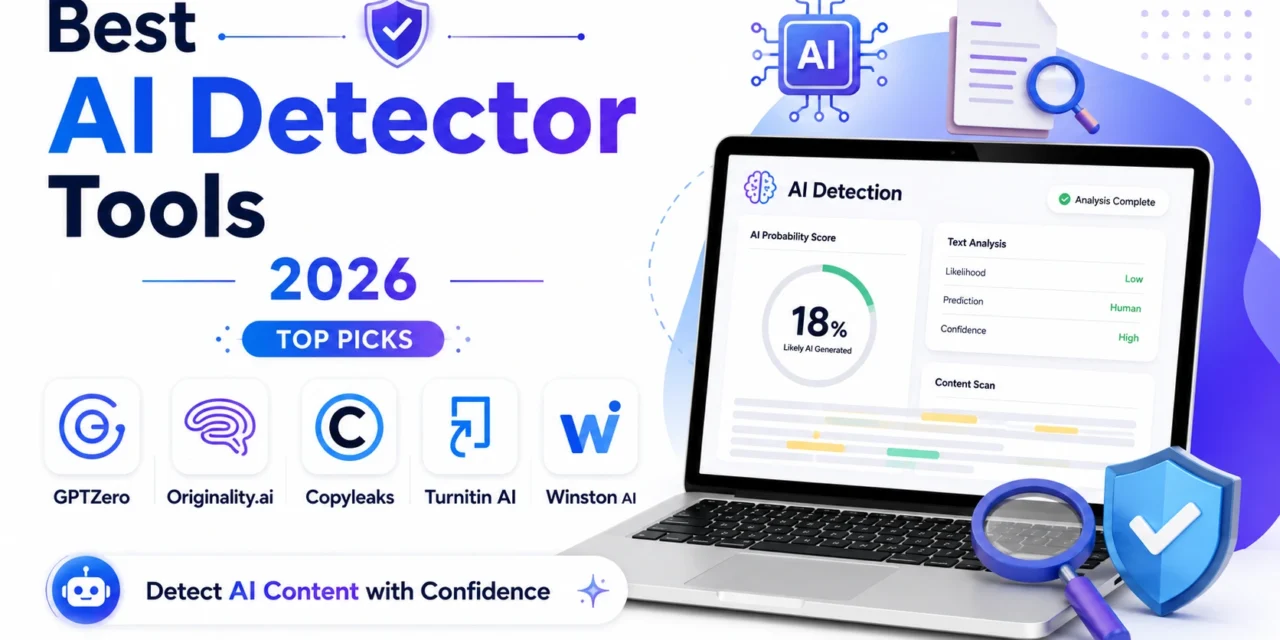
Winston AI emphasizes genuinely detailed reporting that highlights specific flagged sections within a longer document, helping a reviewer understand exactly which parts of a text triggered suspicion rather than just a single overall score.
It’s genuinely important to treat any AI detector’s output as a probabilistic signal rather than definitive proof, since these tools have documented rates of both false positives, flagging genuine human writing as AI-generated, and false negatives, missing genuinely AI-generated text that’s been lightly edited by a human afterward. Educational institutions already using Turnitin for plagiarism get the most natural, integrated workflow from its built-in AI detection rather than adding an entirely separate tool. Publishers and content businesses verifying freelance submissions benefit from Originality.ai’s combined plagiarism and AI detection in one check. Organizations working with genuinely multilingual content should prioritize Copyleaks’ broader language support over tools optimized primarily around English text. Winston AI’s detailed section-level reporting is worth using specifically when a conversation with the actual writer is planned, since pointing to specific flagged passages supports a more productive discussion than a single ambiguous score. It’s also worth running the same piece of text through more than one detector before drawing any conclusions, since different tools can genuinely disagree on the exact same passage.
AI detection tools offer a useful starting signal rather than a definitive verdict, and treating a flagged result as the beginning of a conversation rather than an automatic conclusion avoids the genuine risk of unfairly accusing someone based on an imperfect tool. Use these tools to inform judgment rather than replace it entirely, and stay aware that detection accuracy will keep shifting as the underlying AI writing tools themselves continue to evolve. A tool that’s reliable today may need re-evaluating again within a year as the underlying models change.