
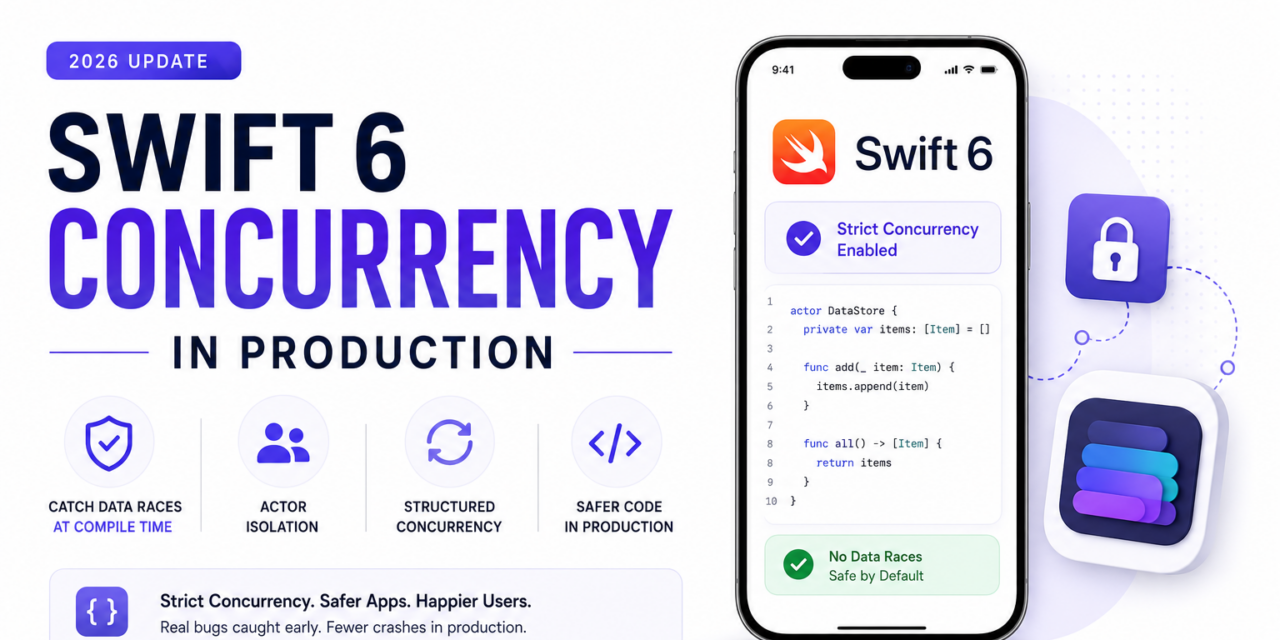
Swift 6’s strict concurrency checking arrived with a genuinely ambitious promise: catch data races at compile time rather than letting them surface as intermittent, hard-to-reproduce crashes in production, by making the compiler enforce safe cross-actor data access throughout an entire codebase. That promise has meant a real, sometimes painful migration for iOS teams adopting the stricter checking, and by 2026 enough teams have gone through that migration in production that a genuinely honest picture has emerged of what actually got better, what remained genuinely difficult, and where the tooling still has real gaps. Here’s an honest look at where Swift 6 concurrency actually stands for iOS teams working in production today.
What Strict Concurrency Actually Catches
The core value proposition has held up well in practice: Swift 6’s strict concurrency checking genuinely does catch real, previously-invisible data race bugs at compile time that would otherwise have shipped and surfaced later as rare, maddeningly hard-to-reproduce crashes in production. Teams that completed a full migration consistently report finding actual latent concurrency bugs during the process, issues that had been sitting in production code for years without triggering a visible crash, simply because the specific timing conditions needed to expose them hadn’t yet occurred in the wild. This alone has been enough to justify the migration for many teams, even accounting for the real short-term pain of getting there, since the alternative is discovering the same class of bug through a user-reported crash rather than a compiler error.
Where the Migration Gets Genuinely Painful
The honest complaint that comes up most consistently is the sheer volume of changes required in large, established codebases, since strict concurrency checking often surfaces dozens or hundreds of previously-silent warnings across a mature app that weren’t written with actor isolation in mind from the start. Older codebases making heavy use of delegate patterns, completion handlers, and shared mutable state across classes tend to require considerably more rework than codebases already built around more modern Swift concurrency patterns like async/await and actors from the outset. Third-party dependencies not yet updated for strict concurrency checking have also been a genuine source of friction, sometimes forcing teams to wait on an external library’s own migration timeline before they can fully adopt strict checking themselves without resorting to unsafe workarounds.
How Teams Are Actually Migrating in 2026
The pattern that’s emerged among teams that migrated successfully isn’t a single big-bang rewrite, it’s an incremental, module-by-module adoption using Swift’s language mode settings to enable strict checking selectively rather than flipping it on for an entire large codebase at once. Apple’s own migration tooling and compiler diagnostics have genuinely improved since Swift 6’s initial release, with clearer, more actionable error messages that point more directly at the actual isolation violation rather than a confusing, indirect symptom of it. Teams with strong existing test coverage report a meaningfully smoother migration overall, since automated tests catch behavioral regressions introduced during the concurrency rework far faster than manual QA would, turning what could be a multi-month blind migration into a series of much smaller, verifiable steps.
Is It Worth Migrating Now
For new projects starting in 2026, adopting Swift 6’s strict concurrency checking from day one is close to a clear default at this point, since building on top of proper actor isolation from the start avoids the retrofit pain entirely and the tooling has matured enough that the learning curve, while real, is considerably gentler than it was at launch. For large, established production codebases, the calculus is more nuanced: teams with strong test coverage and the ability to migrate incrementally, module by module, tend to see the investment pay off within a reasonable timeframe through genuinely fewer concurrency-related crashes, while teams without solid test coverage or the engineering bandwidth for a careful, incremental migration may reasonably choose to delay a full migration a bit longer while the ecosystem, particularly third-party dependencies, continues to catch up.
Looking at where Swift 6 concurrency actually stands after a genuine stretch of production use across the iOS developer community, the honest assessment is that the core promise, catching real concurrency bugs at compile time rather than in production, has held up well and justified the migration pain for most teams that have gone through it. The rough edges that remain are less about the fundamental design being wrong and more about the practical reality of retrofitting strict checking onto large, mature codebases that weren’t originally architected with actor isolation in mind, alongside a third-party dependency ecosystem that’s still gradually catching up to full strict-concurrency compatibility. As that ecosystem continues to mature and more teams complete their own migrations, the collective pain of adoption should continue easing for the teams still ahead of them.
Conclusion
Swift 6’s strict concurrency checking has proven itself a genuinely worthwhile, if sometimes painful, investment for iOS teams in production during 2026, catching real bugs that would otherwise have shipped and surfaced as hard-to-diagnose crashes down the line. For new projects, adopting it from the start remains close to an easy call, and for existing large codebases, an incremental, well-tested migration approach has consistently proven far more manageable than attempting to tackle strict concurrency checking across an entire mature app all at once.