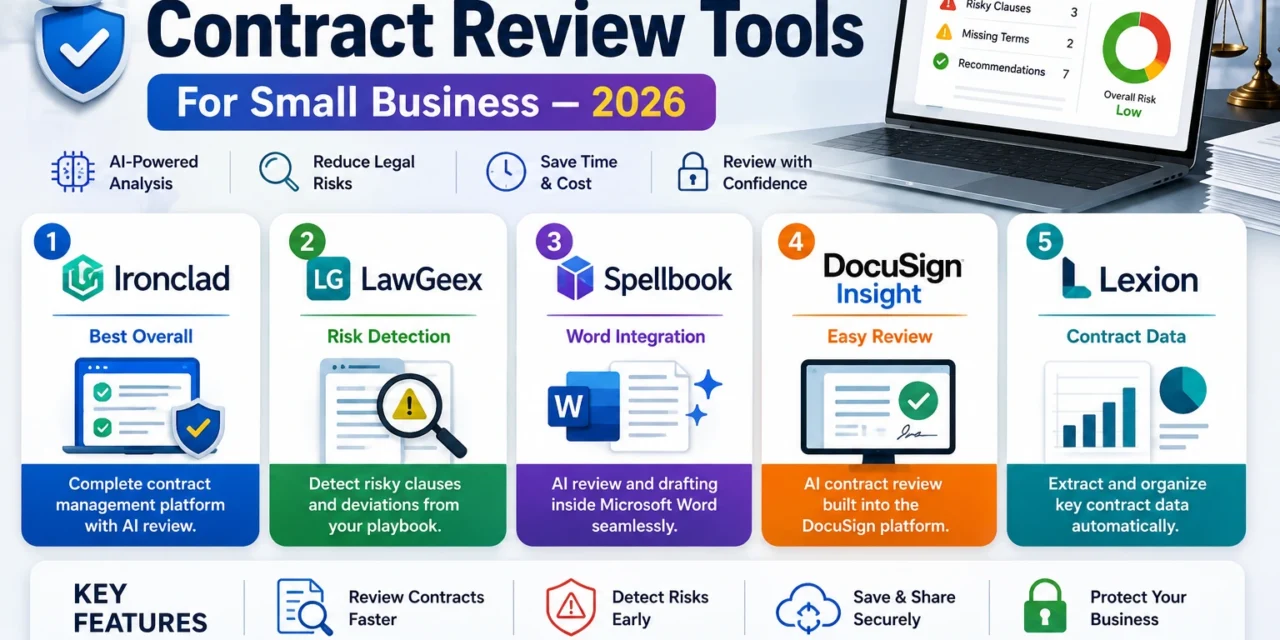
Small businesses regularly sign contracts, vendor agreements, client contracts, leases, without the budget for a lawyer to review every single one in detail, leaving genuine legal risk buried in clauses that a quick manual read-through easily misses. AI contract review tools have changed that calculus considerably, scanning a contract for risky or unusual clauses, missing standard protections, and genuinely flagging specific language worth a closer look or a real lawyer’s attention before signing. Here are five AI contract review tools worth using this year for genuinely catching what a rushed skim tends to miss, while understanding these tools support rather than replace real legal advice for anything genuinely high-stakes. Most also let a business build and reuse a custom playbook of pre-approved terms, making future reviews faster once a company’s specific standard preferences are established.
Ironclad
Ironclad combines AI-assisted contract review with a broader contract lifecycle management platform, appealing to growing businesses that want review, negotiation tracking, and storage handled within one connected system.
LawGeex
LawGeex specializes specifically in automated contract review against a business’s own pre-approved playbook, flagging deviations from standard acceptable terms rather than requiring manual comparison against a template each time.
Spellbook
Spellbook integrates directly into Microsoft Word, letting users get AI-assisted contract review and drafting suggestions without leaving their existing document editing workflow at all.
DocuSign Insight
DocuSign Insight extends DocuSign’s existing e-signature platform with AI-powered contract analysis, appealing to businesses already using DocuSign who want review capability added to a tool they already rely on daily.
Lexion
Lexion combines contract review with organized contract data extraction, automatically pulling key dates and terms into a searchable database, appealing to businesses managing a genuinely large volume of ongoing contracts.
Small businesses without dedicated legal staff should treat these tools as a genuinely useful first pass that flags concerns worth a closer look, rather than a full substitute for real legal counsel on anything with meaningfully high financial or liability stakes. Businesses already using Microsoft Word for contract drafting get the smoothest workflow from Spellbook’s direct Word integration rather than switching to an entirely separate platform. Businesses already on DocuSign for signatures benefit from adding DocuSign Insight rather than an unrelated separate tool. LawGeex’s playbook-based review suits businesses with fairly standardized, repeatable contract types where deviations from a known-good template are the main concern. Lexion’s data extraction is worth prioritizing specifically for businesses managing enough active contracts that manually tracking key dates and renewal terms has become genuinely error-prone. It’s worth testing any shortlisted tool against a contract you’ve already reviewed manually, comparing its flagged concerns against your own findings, before trusting it fully with a genuinely unfamiliar agreement. That direct comparison against your own manual review builds real confidence in a specific tool’s accuracy far faster than reading a vendor’s own marketing claims about its detection capability ever could.
AI contract review tools genuinely close a real gap for small businesses that can’t afford a lawyer reviewing every single agreement in detail, catching concerning language a rushed read-through easily misses. Use these tools to flag what deserves closer attention, and still involve real legal counsel for anything genuinely high-stakes, since these tools support good judgment rather than fully replacing it. The genuine peace of mind that comes from knowing a contract has been carefully scanned for red flags is worth the modest cost even before considering any single clause it might actually catch.