Push notifications have a complicated relationship with app users. At their worst, they are interruptions – unwanted intrusions into attention that cause users to disable notifications entirely or, in the most frustrating cases, uninstall the app generating them. At their best, they are genuinely valuable communications that bring users back to an app at exactly the right moment to find value they would have missed otherwise. In 2026, the gap between these two experiences has become one of the most significant competitive differentiators in the app market.
The Evolution From Engagement Tool to Revenue Channel
The original purpose of push notifications was simple: remind users that an app exists and give them a reason to open it. Early notifications were largely broadcast messages – all users received the same notification at the same time. App store research showed that this approach increased short-term opens but had minimal impact on meaningful engagement metrics and contributed significantly to notification permission opt-out rates.
The shift toward AI-powered personalised notification systems has changed this dynamic significantly. In 2026, the most sophisticated notification systems analyse hundreds of behavioural signals to determine not just what to notify a user about, but when in the day that specific user is most likely to respond positively, what type of message tone they respond to, and how recently they were last notified across any channel.
The Revenue Connection – How Notifications Drive Money
The direct revenue attribution from push notifications has improved in 2026 as attribution systems have become more sophisticated. Retail and e-commerce apps consistently report push notifications as their highest-ROI marketing channel when properly personalised – ahead of email, paid social, and paid search in several major analyses.
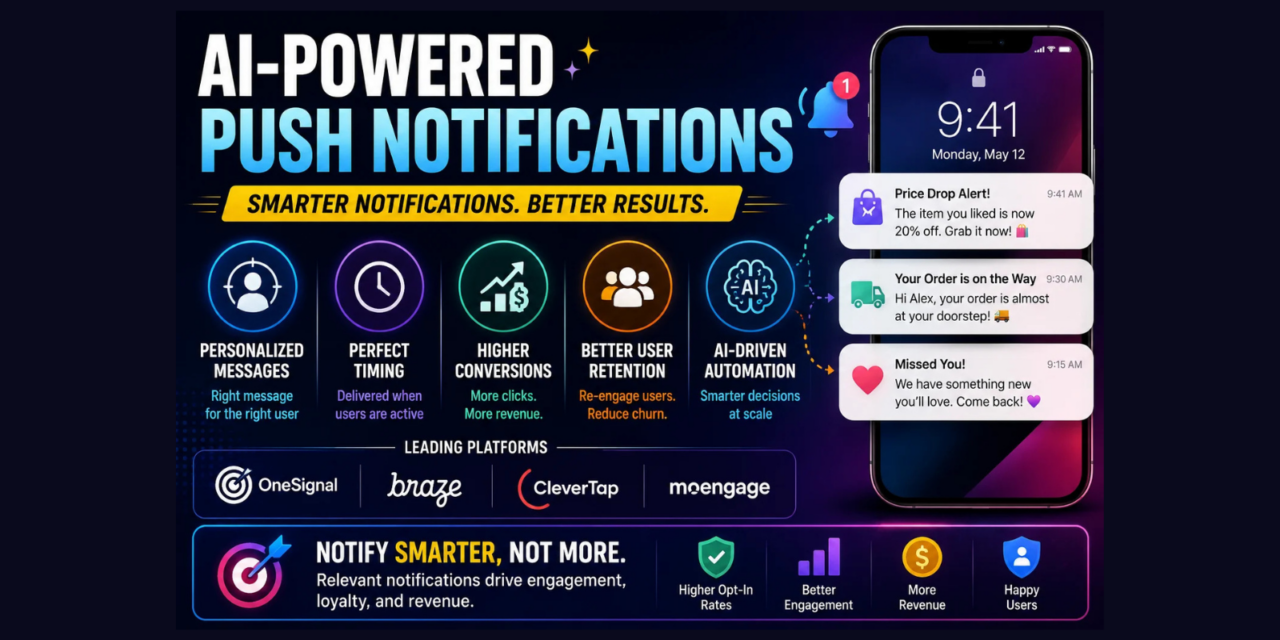
The mechanism is clear for commerce apps: a notification about a price drop on an item a user viewed but did not purchase, sent when that user’s historical pattern suggests they are likely to be browsing their phone, produces a meaningful click-through and conversion rate that broadcast notifications cannot match. The difference between a personalised price-drop alert and a generic ‘New arrivals!’ notification can be a tenfold difference in conversion rate, which translates directly to revenue per notification sent.
For subscription and SaaS apps, notifications play a different revenue role – reducing churn by re-engaging users who are drifting toward cancellation before they formally cancel. Detecting early warning signals of disengagement – declining session frequency, reducing time-in-app, skipping certain features – and sending targeted notifications that reconnect users with value they may have forgotten the app provides is one of the highest-ROI interventions in subscription retention.
The Technology Behind 2026 Notification Personalisation
The notification personalisation infrastructure that top apps use in 2026 involves several layers of technology working together. Data collection tracks app behaviour, purchase history, content preferences, and notification interaction history across sessions. Segmentation divides users into groups sharing meaningful behavioural characteristics that predict notification response differently. Timing optimisation uses machine learning models trained on historical open-rate data to determine the optimal delivery time for each individual user. Content personalisation dynamically generates notification copy, images, and deep links based on each user’s current behavioural context.
Platforms including OneSignal, Braze, CleverTap, and MoEngage provide the infrastructure for this level of personalisation at the scale that most apps operate. The increasing availability of these sophisticated tools through affordable SaaS pricing has democratised advanced notification strategies that previously required large in-house data science teams to implement.
Leading notification platforms include www.onesignal.com, www.braze.com, and www.clevertap.com.
The Opt-In Problem – And How Top Apps Solve It
iOS requires explicit opt-in permission for push notifications, and Android 13 introduced the same requirement for Android apps. Permission opt-in rates vary enormously based on how and when the permission is requested. Apps that ask for notification permission immediately on first launch – without giving the user any context for why notifications would be valuable – consistently achieve opt-in rates in the twenty to thirty percent range.
Apps that use a pre-permission dialog – explaining specifically what notifications the user would receive and the value of each type – before triggering the system permission prompt achieve opt-in rates of fifty to seventy percent for the same user populations. This difference in permission rate compounds significantly over a user base of any meaningful size.
The most effective strategies present the value proposition for notifications at the specific moment where the user would most clearly understand the benefit – typically after they have experienced a core value moment in the app rather than before they have done anything at all.
The Line Between Value and Spam
The commercial incentive to send more notifications runs directly against the user interest in receiving fewer interruptions. Apps that prioritise short-term engagement metrics over user experience tend to send increasing volumes of notifications over time, which drives immediate opens but reduces permission retention and long-term user satisfaction.
The most successful apps in terms of long-term notification economics in 2026 have accepted a constraint that runs counter to the default incentive structure: fewer, higher-quality, more precisely timed notifications produce better long-term revenue than more frequent lower-quality ones, even when the short-term engagement metrics for more frequent notification favour higher volume.
What This Means for App Users
For app users, the 2026 notification landscape is more polarised than ever. Apps that have invested in personalisation technology send notifications that feel genuinely relevant and useful – the right thing at the right time feels like a service rather than an interruption. Apps that have not invested in this infrastructure continue sending broadcast messages that feel like spam regardless of the content’s technical relevance to the user’s interests.
Understanding which category an app falls into before granting notification permission is worthwhile for users who want to avoid notification fatigue. Granting permission selectively – only to apps that have demonstrated they send genuinely useful communications – and revoking permission from apps that send irrelevant or excessive notifications is the most effective way to maintain a notification experience that adds rather than subtracts value from daily life.