The best app launches do not start on launch day. They start weeks earlier – quietly, deliberately, in places most developers never think to look.
By the time the Play Store listing goes live, the developers who understand discovery have already built a search footprint, seeded editorial coverage on Android press platforms, and created an audience that is actively waiting. For these developers, launch day is a confirmation of existing momentum – not a cold start into silence.
This is pre-launch discovery strategy. It is how you give the Play Store algorithm something real to work with before you need it most. And it is the single biggest gap between app launches that generate immediate, sustained downloads and those that generate a quiet Tuesday on the Play Store with no visible cause.
Here is exactly how to get your app discovered before launch – with a week-by-week breakdown at the end.
Why Launch Day Is Already Too Late to Start
Most developers treat the Play Store publish button as the beginning of their marketing effort. In reality, it is the middle of a process that should have started four weeks earlier.
Search engines need time to crawl and index new content. Journalists need lead time to write, edit, and schedule coverage before it publishes. Early users need time to find the app, download it, and leave reviews – and those early reviews feed the Play Store algorithm with the quality signals it uses to decide how prominently to surface your listing to new users. None of this happens instantly. None of it happens on its own.
When a developer launches with zero prior press, zero indexed mentions, and zero community awareness, they are asking the Play Store algorithm to do all the discovery work from a standing start. The algorithm rewards momentum – downloads, ratings, engagement velocity in the first 72 hours. If day one is quiet, the algorithm reads that as low market interest and suppresses the listing accordingly. That suppression is not a temporary state. It shapes the listing’s algorithmic trajectory for weeks.
Pre-launch activity is how you arrive on launch day with momentum already built – and give the algorithm a very different signal to read. Our ongoing coverage of new Android app launches consistently shows this pattern: apps that arrive with pre-launch press and community awareness perform measurably better in their first two weeks than technically equivalent apps that launched without preparation.
1. Build the Search Footprint Before the Listing Goes Live
Before your app is live on the Play Store, you want your app’s name to exist in indexed search results. Not as a paid advertisement – as genuine editorial content that search engines have crawled, indexed, and associated with specific keywords.
The fastest way to accomplish this is a pre-launch press release published on an indexed Android platform. Even if your Play Store listing is not yet live, a press release announcing an upcoming launch – describing what the app does, naming the developer, stating the launch date, and linking to a coming-soon landing page – creates a crawlable, permanently indexed reference point for your app’s name and category.
When someone searches your app name after launch day, that pre-launch coverage is already there. It signals to Google that this is a real, anticipated product with an established public presence – not a brand-new entity with zero prior existence. That distinction matters to both search algorithms and to the journalists who will later research your app before deciding whether to cover it.
Write a concise pre-launch press release two to three weeks before your Play Store listing goes live. Keep it factual and specific: what the app does, who built it, when it launches, what platform it is on, and where to sign up for early access or follow the launch. That is enough to plant the search footprint you need. The full-detail press release comes on launch day – this earlier piece simply establishes that the app exists and is coming.
2. Secure Pre-Launch Coverage Before the Play Store Goes Live
Most developers assume that press coverage always follows the Play Store listing – that you publish the app first, then reach out to press. This is the standard assumption, and it costs developers the most valuable coverage window available to them.
Several press and review platforms accept app submissions ahead of the official Play Store launch date – and coverage that goes live simultaneously with or immediately before your Play Store listing is more valuable than coverage that appears two weeks after, when the algorithm has already formed its initial impression of your app’s momentum.
Pre-launch press coverage accomplishes three things simultaneously that post-launch coverage cannot replicate. First, it indexes your app name on authoritative Android domains before your Play Store listing exists – building topically relevant backlinks to your coming-soon page and later to your Play Store URL. Second, it gives you live editorial links to include in your launch day social posts and pitch emails – “as covered on [outlet]” is a credibility signal that nothing else provides at the same cost. Third, it creates a warm, primed audience of readers who saw the pre-launch piece, became interested, and are ready to download the moment the Play Store listing goes live.
Submitting to press and review platforms like Android News Wire ahead of your Play Store publish date means the editorial coverage and your listing go live in the same window – which is exactly when you need the search and algorithm signals to stack on top of each other rather than arrive separately weeks apart. Coordinating this through a dedicated App Launch Service ensures your timing, formatting, and distribution are handled in one place so nothing slips between the cracks on launch day.
3. Use the Google Play Pre-Register Signal Deliberately
Google Play’s pre-registration feature is consistently under-used and consistently misunderstood. Most developers who know it exists treat it as an email collection mechanism. It is significantly more than that.
When users pre-register for your app on the Play Store, Google directly tracks that expressed intent. Apps that accumulate meaningful pre-registration numbers receive preferential algorithmic treatment on launch day – in the New Releases section, in category browsing placement, and in personalised recommendations served to users whose profile matches your app’s category and behaviour signals. A strong pre-registration count is one of the few things a developer can do before launch that directly improves launch-day algorithmic placement.
To build pre-registrations effectively:
- Set up the Play Store pre-register listing at least three weeks before your launch date – earlier if your development timeline allows
- Include the pre-register URL in your pre-launch press release and in every piece of pre-launch content you publish
- Announce the pre-registration in relevant communities – Reddit, Discord servers, and Facebook groups for your app’s specific category
- Include the pre-register link in your pitch emails to reviewers, so interested journalists can send their own audiences there
Every pre-registration represents a user who has signalled genuine intent before you have spent a rupee on paid acquisition. These are the highest-quality potential early reviewers you have access to – users who found the app interesting enough to take an action without even being able to try it yet.
For a reference point on what strong pre-launch momentum looks like by app category, browse our app submission section – apps that arrive with pre-registration data and pre-launch press links receive significantly more editorial attention in our review queue than those that arrive without this groundwork in place.
4. Seed Your Category Communities Before You Need Them
Every app category has communities where its future users already gather and talk. Productivity app users discuss workflow in productivity subreddits and Discord servers. Fitness app users share routines in Android fitness communities. Budget app users ask questions in personal finance forums. These communities are your pre-launch audience – and the developers who reach them effectively are the ones who were already present in those communities before they had anything to promote.
The tactic requires patience but not money. Become a genuine, contributing participant in the communities where your future users are active. Answer questions that you can answer well. Share genuinely useful content that has nothing to do with your app. Build a presence that the community associates with value, not promotion. This process takes two to three weeks done properly – which is exactly why starting it four weeks before launch is the right timing.
When launch day approaches, make a genuine announcement post that follows each platform’s self-promotion rules precisely. Share the story behind the app – why you built it, what problem you were personally trying to solve, what you learned during development that surprised you. Authentic origin stories travel in communities in ways that press release language never does. A community member who reads your story and identifies with the problem your app solves becomes both a downloader and an advocate – and advocates leave the specific, detailed early reviews that the Play Store algorithm weights most heavily.
A community post that generates 50 engaged comments from genuinely interested users on launch day is worth more to your algorithmic momentum than any single press mention from an outlet whose audience was not specifically looking for your type of app.
5. Build Your Early Reviewer Pipeline Through Beta Access
Play Store ratings in the first 72 hours carry disproportionate algorithmic weight. The Play Store watches early review velocity and quality closely – a cluster of genuine four and five star reviews in the first three days signals product quality and drives visibility in a way that the same reviews arriving two weeks later does not replicate. You cannot manufacture this. But you can earn it legitimately by building a beta tester group in the weeks before launch.
Run a closed beta for two to three weeks before your Play Store listing goes live. Recruit beta testers from your community seeding efforts (Step 4), from your pre-registration list (Step 3), and from your personal and professional network. Give beta users genuine early access, fix the issues they identify during the beta period, and communicate those fixes back to them – so they feel invested in the product’s improvement rather than used as unpaid QA labour.
At launch – not before, to remain fully compliant with Play Store developer policies – simply send a message to your beta group reminding them that the app is now live on the Play Store and that their honest review would mean a great deal to the launch. Beta testers who had a genuinely good experience and feel a sense of investment in the product’s story are your most reliable source of the early, authentic reviews that set a new listing’s algorithmic trajectory in the right direction from day one.
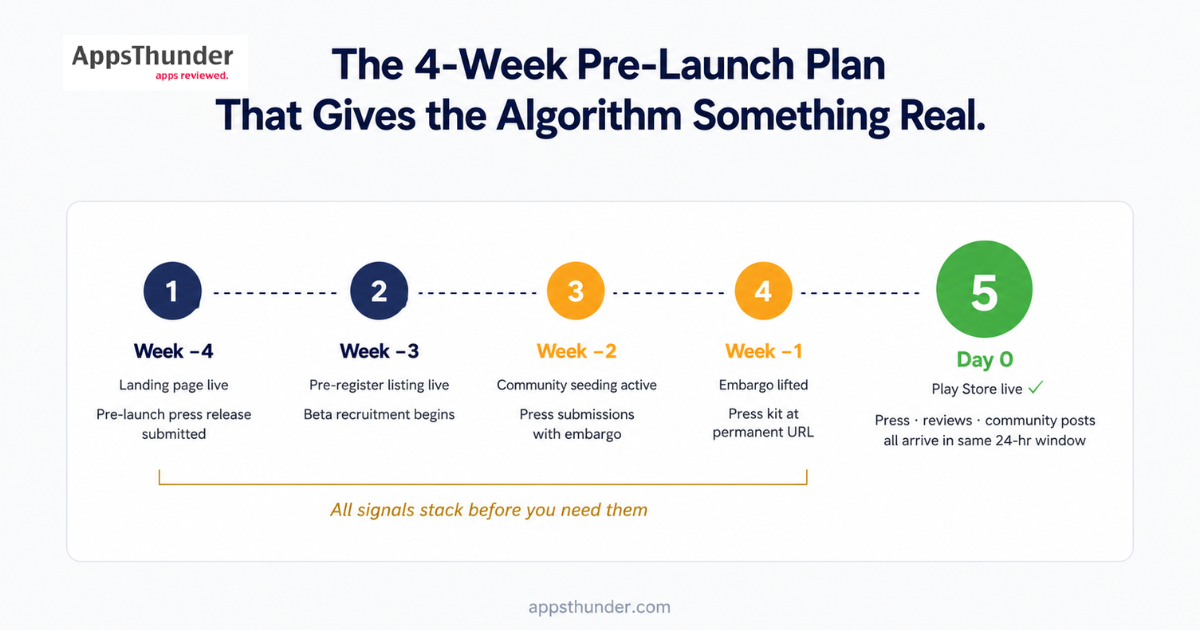
The Pre-Launch Discovery Timeline
| Weeks Before Launch | Action | Goal |
|---|---|---|
| 4 weeks out | Coming-soon landing page live. Pre-launch press release submitted to indexed Android platform. | Search footprint established before listing exists |
| 3 weeks out | Play Store pre-register listing live. Beta tester recruitment begins from personal network and early community presence. | Pre-register signal building. Beta pipeline seeded. |
| 2 weeks out | Community seeding active across category-specific platforms. Press and review platform submissions sent with embargo date. | Warm audience building. Pre-launch editorial coverage secured. |
| 1 week out | Embargo lifted for reviewers who received early access. Final press kit published at permanent public URL. | Editorial coverage ready to publish simultaneously with launch. |
| Launch day | Play Store listing live. Press coverage live. Social posts go out. Respond personally to every early review and comment within 48 hours. | Concentrated arrival of algorithm signals – downloads, reviews, press links – all in the same 24-hour window. |
| Week 1 post-launch | Beta tester reminder message sent. Secondary outlet pitching begins. Developer post-launch transparency note published. | Sustained momentum beyond the initial launch spike. |
Discovery does not happen to apps. It is built – deliberately, piece by piece, in the weeks before the product is available to download. The developers who understand this do not simply launch apps into the Play Store. They release them into an audience that has been preparing to receive them.
Frequently Asked Questions
How far in advance should a developer start pre-launch marketing for an Android app?
Four weeks is the practical minimum for executing all five pre-launch steps effectively. The pre-launch press release needs time to be indexed before the Play Store listing goes live. Community presence needs two to three weeks to build before any promotional announcement. Beta testers need two to three weeks to use the app meaningfully. Starting less than two weeks before launch means compressing the steps that take longest and produce the most value, which negates most of the benefit of doing them at all.
Does the Google Play pre-register feature really affect launch-day algorithmic placement?
Yes – directly and measurably. Google’s Play Store algorithm treats pre-registration count as a signal of anticipated demand. Apps with strong pre-registration numbers receive more prominent placement in the New Releases section, in category browsing, and in personalised recommendations on launch day. The pre-register feature is the only mechanism available to a developer that directly influences launch-day algorithmic treatment before the listing goes live – which makes it one of the highest-leverage pre-launch actions available at zero cost.
What is the best community platform for seeding an Android app pre-launch?
It depends entirely on your app category – which is the correct answer, not a vague one. Reddit’s r/androidapps and r/Android are broadly relevant for general app launches. Category-specific subreddits (r/personalfinance for budget apps, r/productivity for workflow apps, r/fitness for health apps) reach more qualified potential users than broad Android communities. Discord servers for specific app categories or adjacent interests are increasingly effective. Facebook groups for your target demographic remain highly active for family, lifestyle, and local interest apps. The right community is wherever your specific future user already spends time online.
Can I ask beta testers to leave Play Store reviews at launch?
Yes – at launch, not before. Google Play policies do not permit soliciting reviews of an app before it is publicly available on the Play Store. Once the listing is live, you can message your beta group to let them know the app has launched and that their honest review would be appreciated. The word “honest” matters – do not instruct beta testers on what rating to leave or what to say. Genuine reviews from real users who had a real experience are both policy-compliant and algorithmically more valuable than coordinated five-star submissions.
How do I submit my app to AppsThunder for pre-launch coverage consideration?
Use our app submission page and include your pre-launch press release link, your coming-soon landing page or pre-register URL, and your media asset pack. We cover Android and iOS apps across all categories. Apps submitted with a complete press release and pre-launch context receive priority review consideration. We also offer featured review options through our partnership with AppMarketingPlus for developers who want guaranteed placement alongside editorial review.
AppsThunder covers the most interesting new Android and iOS apps before they go mainstream. Submit your upcoming launch via our app submission page. We review apps independently – editorial selection is not influenced by advertising.