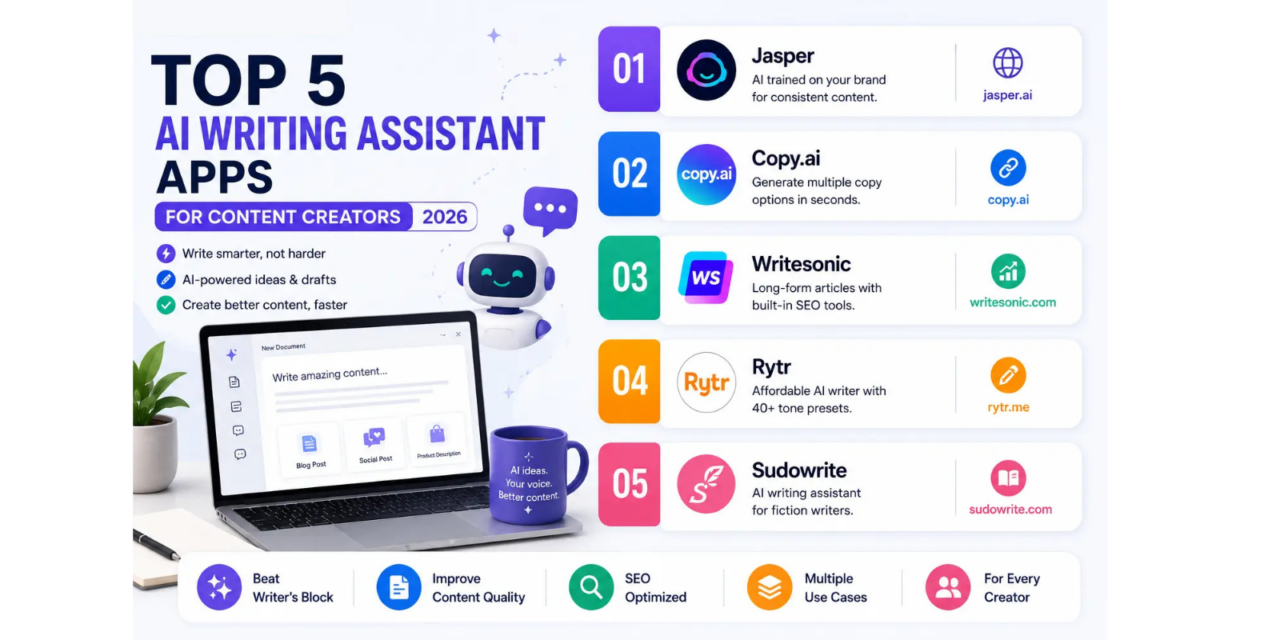
The blank page is still the hardest part of content creation, and AI writing assistants have gotten remarkably good at breaking that specific kind of paralysis, generating a rough first draft you can shape rather than starting from an empty document with a blinking cursor. The best tools in 2026 aren’t trying to replace a creator’s voice entirely, they’re trying to get out of the way faster, handling outlines, headlines, and repetitive formats so the human writer can focus on the parts that actually need a real perspective and personal experience behind them. Pricing has also gotten more accessible, with most tools offering usable free tiers before asking creators to commit to a monthly subscription. Here are five AI writing assistants worth trying this year, each suited to a slightly different kind of content work.
Jasper
Jasper remains a favorite among marketing teams for its brand voice training, letting the AI learn a company’s specific tone across dozens of past posts so output stays consistent across a whole content calendar rather than sounding like a different writer every time.
Copy.ai
Copy.ai leans into short-form output like ad copy, product descriptions, and social captions, generating dozens of variations at once so creators can quickly pick the angle that fits best rather than staring at one option and hoping it works.
Writesonic
Writesonic bundles long-form article generation with built-in SEO scoring, checking keyword usage and readability as it drafts so creators aren’t writing blind to how the piece will actually perform once it goes live and gets indexed.
Rytr
Rytr targets budget-conscious creators with a generous free tier and a huge library of tone presets, making it an approachable entry point for anyone testing whether AI writing tools genuinely fit their workflow before committing to a paid plan.
Sudowrite

Sudowrite is built specifically for fiction writers rather than marketers, offering tools to expand scenes, brainstorm plot twists, and rewrite passages in a chosen style, a genuinely different focus from the marketing-heavy tools that dominate this category.
Matching the tool to the actual output format matters more than picking whichever app has the flashiest marketing. Long-form bloggers and SEO-focused writers will get more consistent mileage out of Writesonic’s built-in optimization scoring than out of a tool built for punchy ad copy. Social media managers producing dozens of short captions a day are better served by Copy.ai’s rapid variation generation than a slower, brand-voice-heavy tool designed for fewer, more polished pieces. Fiction writers specifically should steer clear of the marketing-focused tools entirely, since Sudowrite’s scene-expansion and style-matching features solve genuinely different problems than ad copy generators do. It’s also worth testing the free tier of two or three tools side by side on the exact same piece of writing before committing to a subscription, since output quality varies more by use case than most comparison charts suggest upfront. Pricing tiers are also worth reading carefully rather than skimming, since several of these tools cap monthly word generation at a level that heavy daily users burn through well before the billing cycle resets, turning an apparently cheap plan into a mid-month upgrade prompt.
AI writing tools work best when treated as a fast first-draft partner rather than a finished-product generator, since the editing pass is still where a creator’s real voice and judgment come through most clearly. Try one against your actual workflow rather than judging it off a polished demo video, since fit varies a lot depending on whether you’re writing ads, long-form articles, or fiction.